The seasonal movement of people and animals from the valley in winter up to high mountain pastures in summer is an age-old practice in the Alps, at least as far back as ca. 3'000 BC. Today's practice is unchanged from the Middle Ages.

The Alp Aufstieg (ascent to high pastures)
In Switzerland about 380,000 cattle (of which 130'000 are milk cows), 200'000 sheep, goats and alpacas, are taken up to high pastures each year. This practice has shaped much of landscape of the Alps - without it, most areas below 2'000 m/6'000 ft would be forest.

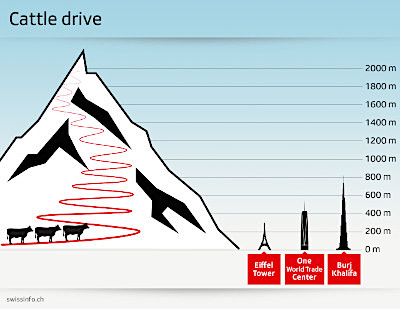
On average, the animals climb 590 meters in altitude and 16.3 km as the crow flies. In reality, however, the route over often steep zigzag paths is much longer. Some cows are even led up more than 2000 meters.
In Spring (April-May) the herdsmen take the animals up to middle pastures (Maiensäss). In Summer the animals are moved up further to the high pastures (up to 2'000 m/6500 ft) where the forage on the alpine pastures is richer and more nutritious than the grass on the lower pastures.
Summer on the high alpine pastures
By eating hundreds of different grasses and herbs and flowers on the alpine pastures, the cows produce milk with a special aromatic flavor, which differs depending on the region; this in turn flavors the cheese that is produced which, as "alpine cheese", commands the highest prices.
Up on the high pastures, the air temperature is cooler and healthier for the animals and they are less prone to fungal infections and insect infestations.

The chief shepherd in charge of an Alp, called a SENN (German) or ARMAILLI (French), is responsible for cheese production. Helpers looks after the animals of several different owners who stay down in the valley to tend their crops.
The shepherds share the hut with the animals, and it is their task to take the cows to pasture and milk them twice a day, and then to make the milk into cheese.
Work up in the Alps is long, hard and poorly paid - 14 hours a day for 4 months, with no time off ... but dreams of sun and freedom and pure mountain air has powerful attraction for many city dwellers - every year many city professionals look after the cows. All have to take a qualification first, and must spend at least one season as a helper before being allowed to go up alone.
In the Fall, the weather gets worse and the grass on the alpine pastures becomes sparser, so the herdsmen and women bring the animals back down to the valley. The return of the cows in the Fall is known as the “Alpabzug” and is often accompanied by a local festival.
The Alpabzug or Désalpe (Homecoming) Festival
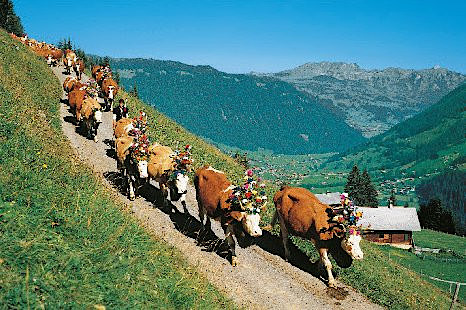
Every year, usually in the 3rd week in September, the animals which spent the summer grazing on alpine pastures all summer, are brought back down to the valleys in a procession called the Alpabzug or Désalpe.
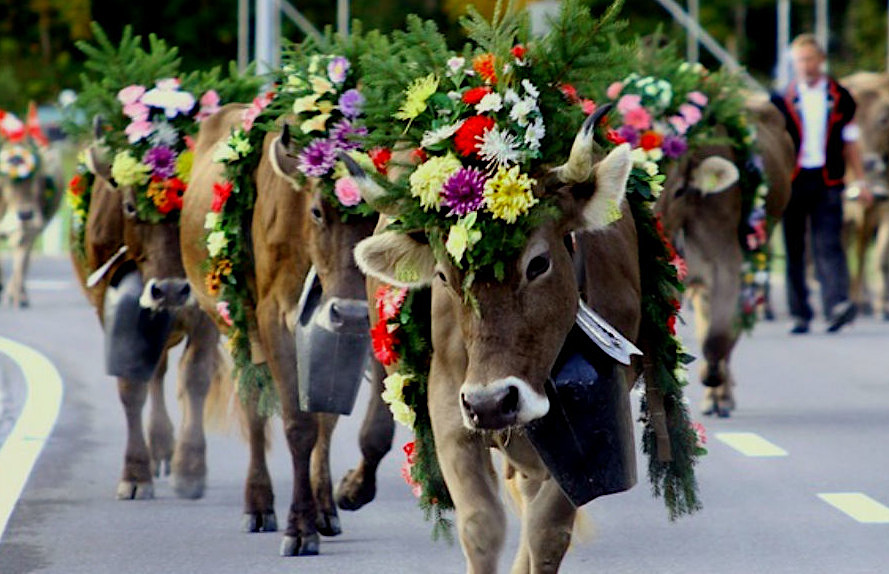
In Alpine villages all around Switzerland, farmers adorn their herds with elaborate flower headdresses, garlands or embroidered pieces, and large jangling cowbells in festive celebration as they parade through the streets.


The parade begins at the crack of dawn on the mountainsides where the cows commence their slow and steady decline. By dusk, the cows complete their journey back home safe in their stables at the bottom of the valley for a much needed rest.

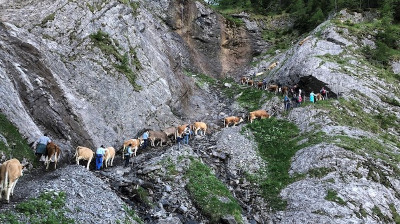
The spectacular cattle ascents and descents are part of the traditional Alpine festivals. On the way to and from their high pastures, the animals sometimes have an extreme journey walking on with narrow, steep and rocky paths.


In the Appenzell region (Eastern Switzerland) the cows are led by the white, hornless Appenzeller Gäässe (goats) tended by children in traditional costumes. The goats are followed by the milk cows, heifers and calves, a steer and the horse pulling the Ledi (a wooden wagon with two axles), which has room for all the equipment that was once needed in the Alps for making cheese and butter.
Cattle owners are dressed in brown and walk at the very end of the procession.


Once back down in the valley the animals are sorted and reclaimed by their owners.

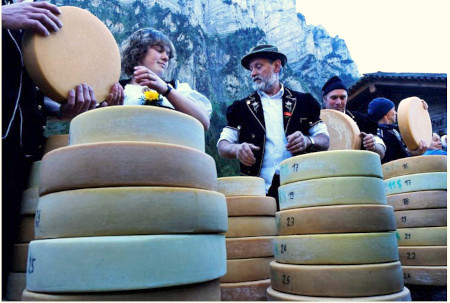
And the farmers divide the alpine cheese made during the summer among themselves and celebrate the end of the alpine summer with a festival of music and merry-making.
The most important thing about every alpine ascent and descent are the three bell cows, which are led by an alpine herdsman wearing a traditional festive costume. The most important job of the four alpine herdsmen walking behind the bell cows is to sing and yodel to the three instruments, which―like nowhere else in the world―are played by cows.


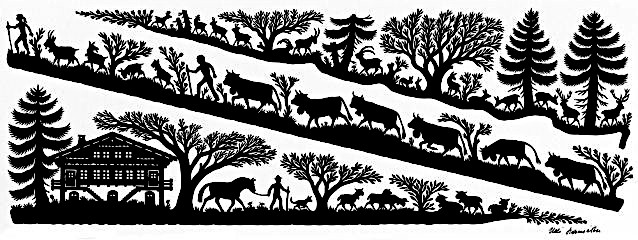
This age-old tradition of alpine ascent and descent is also a frequent motif in that other very traditional activity - paper-cutting ot Scherenschnitt.