Basic info for the day
- Morning - return by Mont-Blanc Express from Chamonix back to Martigny in Switzerland, a key town in ancient Roman times exhibiting many Roman ruins including a small coliseum.
- Stop for lunch in Martigny.
- Afternoon - travel up the Rhône Valley, the country's largest wine and fruit growing region, ringed by majestic Alpine scenery. At Brig switch to the fast train to Milan (Italy) that races through the historic Simplon Tunnel connecting the two countries.
- At Domodossola (Italy) change to the Centovalli (One Hundred Valleys) Express, taking a slow journey back to Switzerland through age-old villages, forests and beautiful nature. Along the 52 km journey, relive a hundred years of epic railway history as you cross over 83 bridges, and pass through 31 galleries—all in just under 2 hours, before reaching Locarno and Lake Maggiore.
- Dinner at the hotel.
Martigny
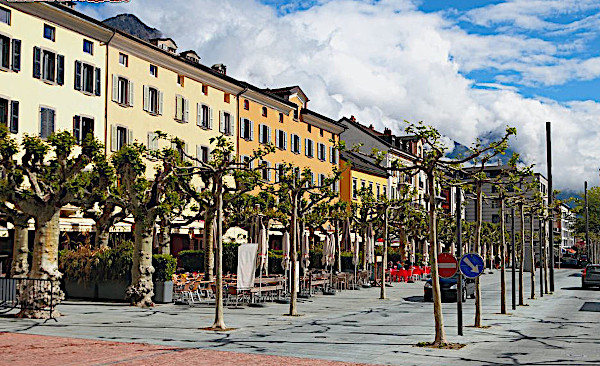
Elevation 471 m (1'545 ft); population approx 20'000 inhabitants.
Strategic location at the point where roads joining Italy, France and Switzerland converge, and at the point where the southwest-flowing Rhone river turns ninety degrees northward and heads toward Lake Geneva.
History - Evidence of human settlement goes back thousands of years. In 57 BC the Celtic settlement was conquered by the Romans in order to control the strategically important Alpine pass known today as the Great-St-Bernard Pass. The Romans renamed the settlement Octodurus and built a flourishing town with proper water supplies, amphitheatre, temples and thermal baths, the ruins of which are still being excavated.
In the Middle Ages, the town took Martin of Tours as its patron saint, and became known by the Latin name as Martiniacum, which later morphed into Martigny.
Martigny was connected to the Simplon railway in 1878 and much later was connected to the Swiss motorway system in 1981.
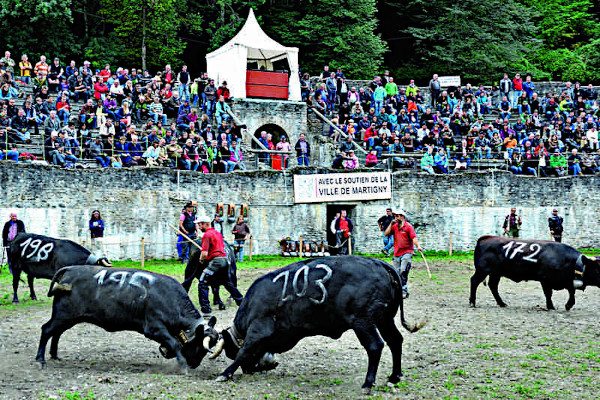
The economy of Martigny is traditionally based on agriculture and viticulture. In May every year the national Herrens fighting-cow championship takes place in the old Roman amphitheatre.
Centovalli Railway
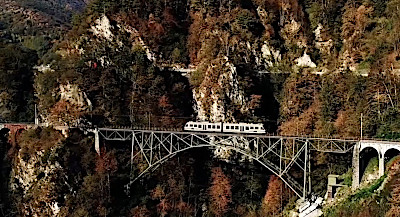
The Centovalli Railway is 52 kms (32 miles) of narrow gauge rail line, 83 bridges and 34 tunnels which connects Locarno, Switzerland and Domodossola, Italy.
It is one of the most scenic routes in southern Switzerland, a 2-hour ride winding over high viaducts, along deep ravines and gorges, past steep rock faces and rushing waterfalls, hillside vineyards, through forests of chestnut and beech trees, and slate-roofed hamlets, and around sharp hair-raising bends.
Key info on LOCARNO
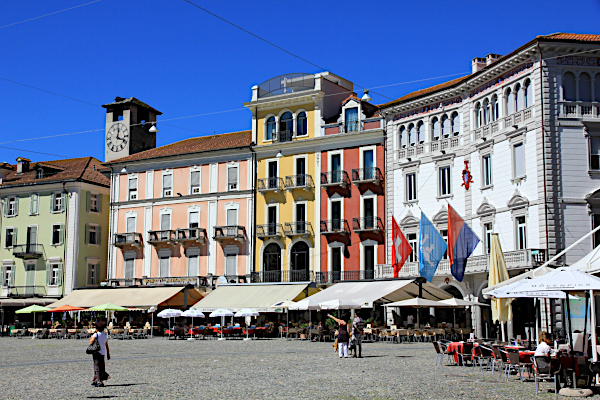
Location - on the northern shore of Lake Maggiore where the Maggia River enters the lake.
Population - 16'000 in the city and 56'000 in the agglomeration including Ascona and smaller neighbouring towns.
History - it has a long history with evidence of continuous human settlement dating back to Early Bronze Age (ca. 14th century BC). It was an ancient Roman settlement but intensive agricultural activity has destroyed most traces of the ancient city.
During the Middle Ages, the capitanei, a group of prominent noble families controlled Locarno.The community managed its common goods (alpine pastures, pastures, forests, churches) and tax officials and police.
In 1164 it gained market rights and due to these privileges, Locarno developed substantial local autonomy. The nobles (Nobili) lost rights to the citizens (borghesi) who had their own administration and various privileges, including the right to their own weights, maintenance of mills, and fishing and grazing rights. The town developed into a thriving commercial centre due to its location on an important road linking the major cities of Lombardy with Germany.
1516 the Swiss Confederates occupied Locarno. The 12 cantons in the Swiss Confederation at that time took turns appointing a governor (Italian: commissario) to rule over Locarno.
16th century - Locarno's population declined as a result of the exodus of Protestants after the Reformation and the plague in 1576–77. The population declined again considerably in the 18th century with poverty driving thousands to emigrate to Milan and Turin.
City of Peace - in October 1925 at the city hall in Locarno, the Treaties of Locarno were negotiated and signed by delegations from Germany, France, Belgium, Great Britain, Italy, Poland and Czechoslovakia to mutually guarantee peace in western Europe; from this, Locarno gained the designation "City of Peace" and the leaders of the British, French and German delegations were awarded the Nobel Peace Prize for 1925.
Film Festival - since 1946 the town has hosted the Locarno International Film Festival every August with open-air screenings at the main square, the Piazza Grande; the main prize is known as the Golden Leopard.
Twin city with Lompoc CA; Venice and Urbino(Italy)