Gotthard
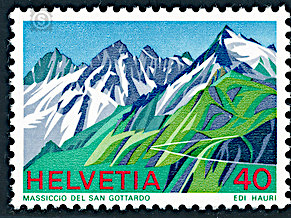
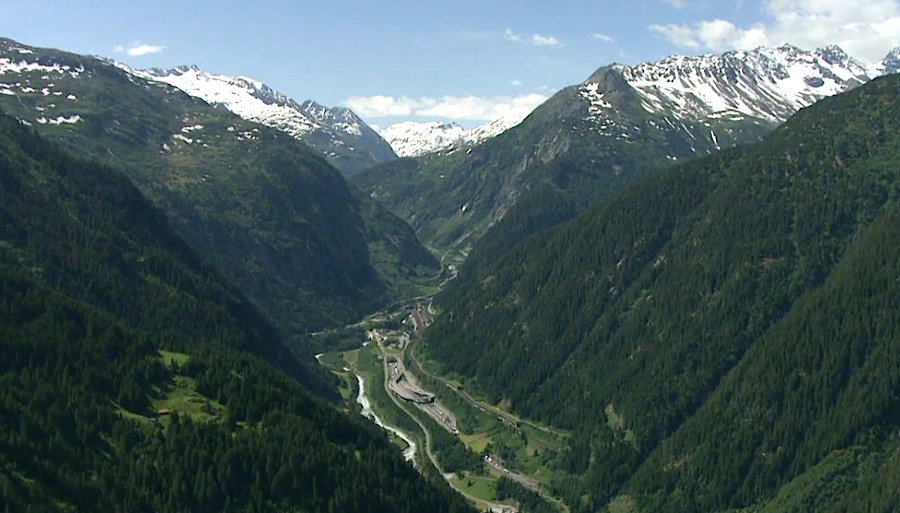
The Gotthard is named after the patron saint of mountain passes and is called the "King of Mountain Passes". It is also called the "Water Tower of Europe" since it is the source of 4 of Europe's major rivers (Rhine, Rhône, Reuss, Ticino). Due to its central location in the Alps it was believed to be the highest point in the Alps right up to the late 18th century .
For the Swiss, the Gotthard has great symbolic significance being a reminder of its determination to overcome insurmountable hurdles and capacity for innovation. Today it is the main North-South transport axis of Europe and carries huge volumes of traffic through the 3 tunnels, including the world's longest railway tunnel, that cross its heart.
Making a viable route through the Gotthard
A winding route through the Gotthard Massif had been known since ancient times but it was little used until the 13th century due to its steepness and the difficulty of crossing the treacherous steep-sided Schöllenen Gorge.

In around 1220 a footbridge suspended over the Schöllenen Gorge was constructed and with the associated bridle path used by pack-mules during the summer months, it soon became a vital trade route between Northern and southern Europe. In Switzerland the region north of the Gotthard became the nucleus of the Swiss Confederation since the need to manage and protect the Pass and the income from it was a major factor in forging the alliance of the 3 original cantons in the 13th century.

In the early 1700s a new pass road was built; this included a 60 m (180 ft) long tunnel - the first tunnel in the Alps. In 1830 a new bridge (Devil's Bridge) was constructed over the Schöllenen Gorge and a cobble-stone paved road was built allowing transport service by 10-seater stagecoaches pulled by 5 horses.
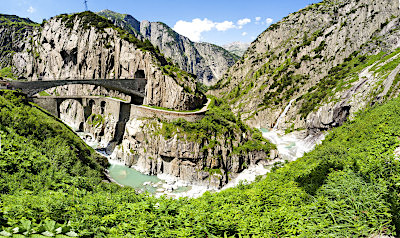
Schöllenen Gorge
The Gotthard Pass (elevation 2,106 m/6,909 ft)
The Gotthard Pass is a key geographical and cultural meeting point. It is where the German-speaking canton of Uri meets the Italian-speaking canton of Ticino, so where German and Italian cultures come together.
It is also a key military strategic point. In the surrounding mountain peaks and rock faces is the Sasso San Gotthardo, 3 kms of tunnels and bunkers built in 1941 and a closely guarded military secret until 2001. This was where the "Reduit" (National Redoubt) strategy of the Swiss Military during WW2 was centred - a strategy to protect the Alps and the passes from invasion.
See: Swiss Military Bunkers - Sasso San Gottardo

The only major battle to take place in the Gotthard was in 1799 when the great Russian General Suvorov and his 21'000 troops faced off an attack by Napoleon's troops during the French invasion of Switzerland.
The Gotthard Railway line
In the 19th century many railway lines connected all parts of Europe except for the most efficient connection linking North and South through the central section of the Alps was missing. The eventual construction of a railway route through the Gotthard Massif was an massive achievement that totally changed the face of commerce and travel across 19th century Europe.

To prevent Switzerland being by-passed by rapid railway development happening in the rest of Europe, Alfred Escher (1819-1882), influential Swiss politician and businessman, pushed the Federal Council to approve Gotthard route through the Alps. He had already set up the Nordostbahn (North-East Railway) based in Zürich and to provide technical know-how and money for railway development, was instrumental in setting up the Swiss Credit Institute to raise finance, and the Federal Institute of Technology (ETH) to provide trained engineers.
After the Federal Council secured financial backing from Germany and Italy, a railway following the ancient traders and pilgrims way through the Gotthard Massif was approved. In 1870 Escher helped found the Gotthard Railway Company to build and operate the line.

Statue of Alfred Escher in front of Zürich main station
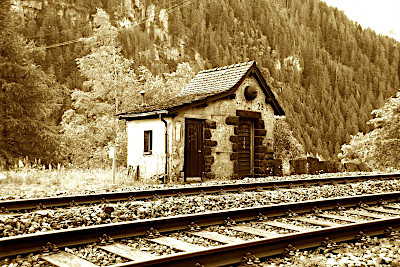
Building a railway line through the Gotthard 150 years ago was a massive undertaking due to technical and geological factors. The Chief Engineer and a team of cartographers and geologists asked local inhabitants all through the valley where avalanches and river torrents came down. They then designed the best route and built in safety features like tunnels, bridges, galleries, avalanche barriers, retaining walls, and a system of manned huts at regular intervals for railway guards and danger lookouts.
Innovative Spiral Tunnels
Extreme differences in altitude, from 475 m/1560 ft at Erstfeld up to the Gotthard Tunnel at 1,151 m/3,776 ft and then down again to 241 m/790 ft above sea level demanded ingenious engineering solutions.
To solve the problem, a route that required a 15 km (9,3 mile) tunnel under the Gotthard pass itself along with 7 additional long spiral tunnel approaches was designed. These spiral tunnels allow the trains to gain/lose height at a steady 7% gradient by increasing the distance the train travels

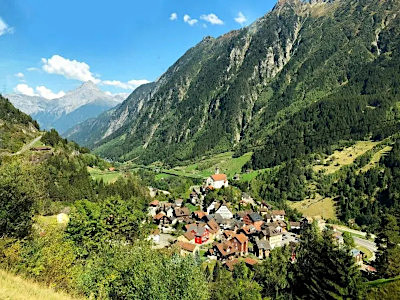
This is best seen by watching out for the little Wassen Church perched on a hill. You see the same church three times from different angles as the train does two loops inside the mountain around the church in order to gain altitude on a gradual gradient.
Louis Favre builds the first Gotthard Railway Tunnel
The most difficult part of the Gotthard project was boring a 15 km/9 mi long tunnel at an altitude of 1,150 m/3,770 ft; a tunnel this long had never been built before and when it eventually opened in 1882, it was the longest tunnel in the world.
Aug 1872 Swiss engineer, Louis Favre, and his company won the contract to build the main tunnel by underbidding 6 other companies. His tender stated it would take 8 years and 56 million Swiss francs to complete the job (or 1 year and 12,5 million francs less than the next lowest bid). This was a serious miscalculation for although he successfully completed the tunnel, it also lead to his financial ruin and ultimately his death.
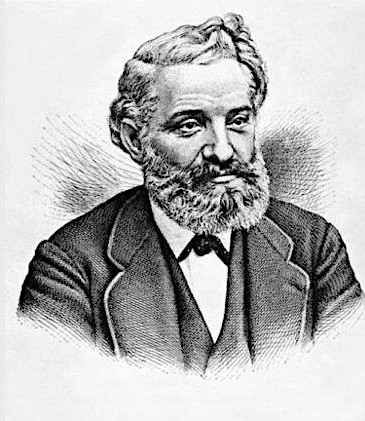
Sept 1872, construction of the main tunnel began. Two crews bored into the rock from each side, eventually meeting about 4½ miles under the mountain just 33 cm/13 inches off from each other horizontally and 5 cm/2 inches off vertically – an incredible feat of engineering.
The Gotthard Tunnel was the first project to use Alfred Nobel's (of Nobel Prizes fame) newly-invented product «dynamite» for peaceful civilian engineering uses.

Low wages and high danger caused great worker discontent and strikes. Legal disputes with lender banks and the Gotthard Railway Company also delayed the project. Eventually the tunnel was completed 10 months late, a financial disaster for Favre due to over-run penalties and his company was driven into bankruptcy. Favre died in 1879 while on an inspection tour of the tunnel just before the tunnel was broken through.
In 1880, when a small opening was made between the two tunnel excavations, working north and south to meet under the mountain, a tin canister was pushed through the tiny gap first. The canister bore the image of Favre, so that despite his death, he came to be the "first person" to pass through the tunnel.
Opening of the Gotthard railway route 1882
After 10 years of construction, the railway itself opened on May 22, 1882 becoming the first railway line to cross the Alps.
For Switzerland it became a key strategic position defended by a line of bunker-fortresses and ways to block the tunnel in case of an invasion, such as artificial landslides to block the tunnel entrances.
During the 2nd World War, the Swiss fiercely guarded their trans-Alpine railway crossing and made it known that they had mined the north and south entrances to the tunnel which would be detonated in the event of any invasion so removing any strategic value for an enemy force in holding the Gotthard Pass route.

Gotthard Base Tunnel opens in 2016
Following a referendum on protecting the Alpine environment overwhelmingly voted for by the Swiss voters, the Swiss Parliament passed the Alpine Protection Act of 1994 which requires freight transporters to reduce the environmental impact of trucks going through the Alps by shifting to train transportation.
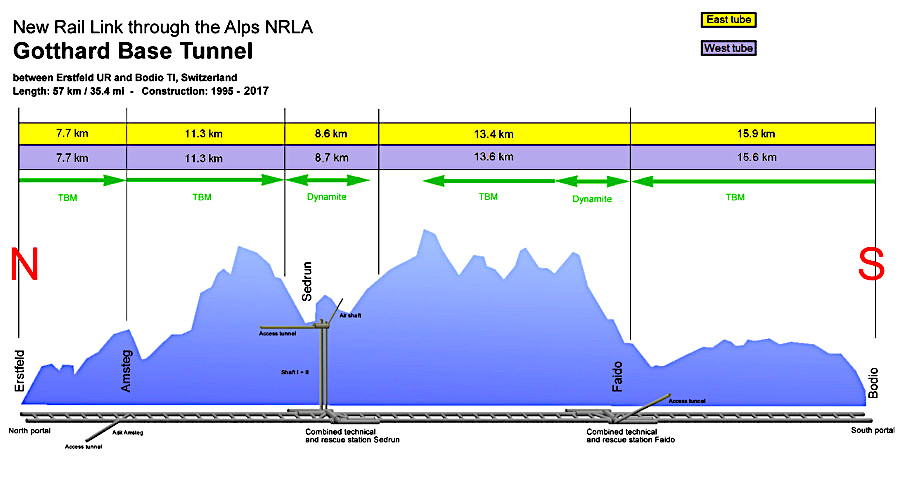
As a result, in June 2016, the world's longest and deepest land tunnel, the Gotthard Base Tunnel, was opened. At 57 kms (35 mi), at 550 m above sea level underneath 2,450 m/8,040 ft of mountain, this major engineering project took 12 years to build. It provides a high-speed flat route through the Alps for the first time, another game-changer in the European travel brought by the Swiss at the Gotthard.
The tunnel is designed for maximum speeds of 250 kph (155 mph) although currently cargo trains run at 230 kph and passenger trains at 200 kph.