Basic info for the day
- Take a local train to Alpnachstad and transfer to the PilatusBahn for your ascent to the top of the 2'073 m (6'801 ft) Mt Pilatus via the world's steepest cogwheel train.
- Enjoy beautiful alpine scenery, take a walk along the "Flower Trail", go through the "Dragon Caves", hike up to the cross for 360 deg views over Lake Lucerne below, watch out for the ibex and chamois.
- Descend via the "Dragon Ride" cableway to Fräkmüntegg where there is a switch to 4-person gondolas for a scenic ride down to the valley station at Kriens, a neighboring municipality to Lucerne; take local bus back into town.
- Dinner and fun folklore show at the Stadtkeller ends the first day of the tour.

Pilatus tour route map
Mt Pilatus and the Pilatus Railway
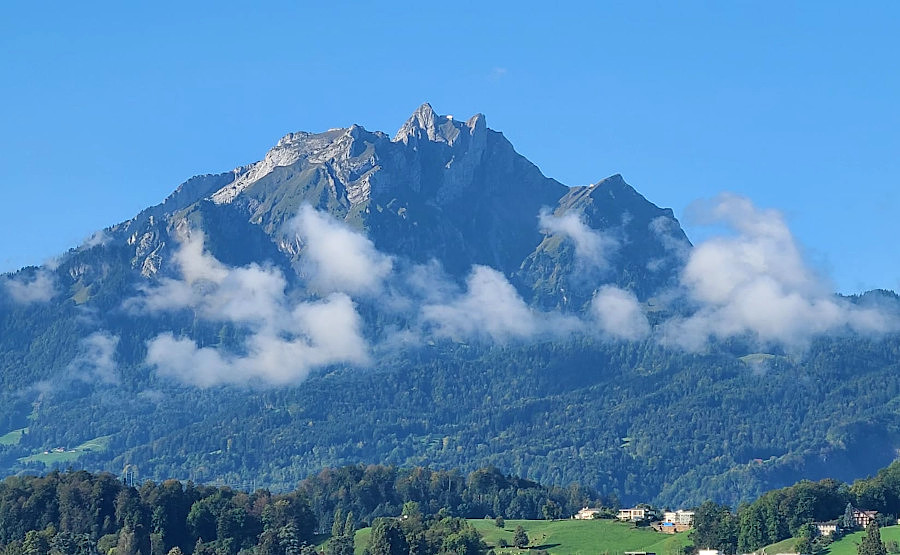
Mount Pilatus is the name of the mountain massif overlooking Lucerne; its highest point, the Tomlishorn is 2'128 m (6'983 ft) above sea level. It straddles 3 cantons - Lucerne, Obwalden and Nidwalden. For geologists, Mount Pilatus is the northernmost branch of the Alps.
In earlier days it supplied timber for the construction of the old wharfs at Rotterdam; today it is a nature conservation area and favourite mountain for hiking. It was first ascended in the 14th century. Before the railway opened in 1889, people were carried up in sedan chairs, including Queen Victoria, although Theodore Roosevelt climbed it himself.
The mountain is used to forecast weather for the area; Mark Twain wrote "Whenever Pilatus appears in the morning without his cloud turban and stands bare-headed under the sky, it is not a prophesy of fair weather but of foul."

The Pilatus Railway, with a maximum gradient of 48% and an average gradient of 35%, was the steepest rack railway in the world when it opened, a record it still holds 136 years later.
The line was opened in June 1889 and carried 35,000 passengers in its first year of operation. By 1901 it had carried a million passengers to the top of the Pilatus by rail.
The line is 4.6 km (2.85 mi) long, climbs a vertical distance of 1'629 m (5'340 ft) and is of 800 mm (31.3 in) gauge. All rails are laid on solid rock secured by high-strength iron ties attached to the rock, without using any ballast.
The line still uses original rack rails that are now over 100 years old. Although they have worn down, by turning them over a new wearing surface is provided, sufficient for the next century.
The railway line came about after the immediate success of the rack rail up Mt Rigi opened in 1871 encouraged a rush of proposals to build rack railways up other mountains.
While the Riggenbach cogwheel system used on Mt Rigi has a maximum gradient tolerance of 25%, Mt Pilatus required something more ingenious. Swiss engineer Edouard Locher designed a system with gear teeth cut in the sides rather than the top of the rail, engaged by two cog wheels on the locomotive.
This design eliminated the possibility of the cogwheels jumping out of the rack on steeper than 25% gradients, and prevented the railcar from toppling over, even under severe crosswinds common in the area.
In 2001 the American Society of Mechanical Engineers named the Pilatus Railway a "Historic Mechanical Engineering Landmark".