
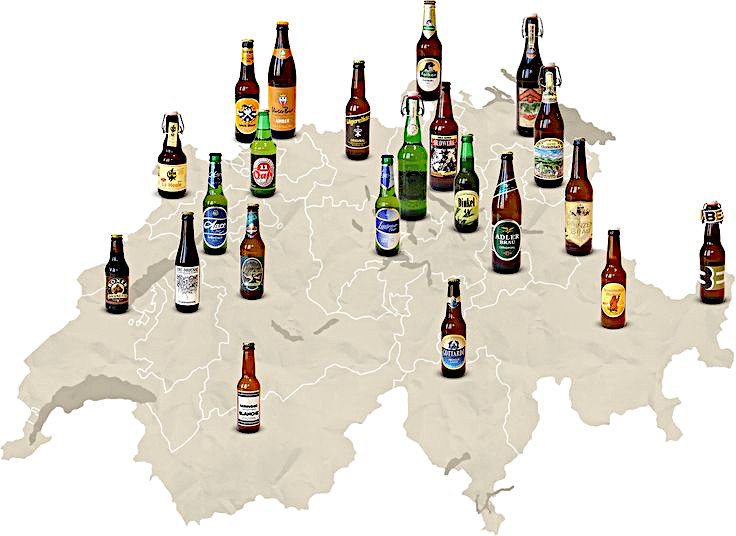
Early history of beer in Switzerland
Beer brewing and drinking in what would become Switzerland began way back with the Celtic tribes who lived around 450 BC to the 1st century BC. Traces of beer, along with mead and wine, have been found in pots excavated at Celtic settlements.
During the Middle Ages, beer brewing was a well-established activity in the many monasteries. The famous Plan of Saint Gall, an architectural drawing dating from the 9th century, depicts renovations for the monastery of Saint Gallen with three large breweries.
The Swiss beer industry was given a tremendous boost from 1860 to 1880 when the phylloxera epidemic largely wiped out wine production, creating a demand for a safe alternative alcoholic drink. Dozens of local breweries expanded production, even bringing in specialised workforces from German breweries.
By the end of the 19th Century, there were about 500 domestic breweries in Switzerland resulting in a chaotic scrabble for customers and low prices.
The Swiss Beer Cartel
In 1935 the largest breweries established a beer cartel to control distribution channels, set beer prices for restaurants and retail outlets, and divided up the country into strict territories for each company.
Members of the Swiss Brewers' Association promised to stop poaching each other's customers. They standardised their beer, and advertising was financed collectively by the association. Smaller breweries were forced out of business or were absorbed by the bigger players.
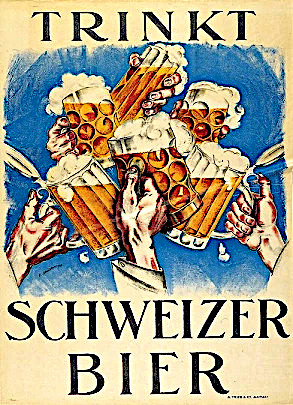
Advert by the Swiss Brewers' Association - "Drink Swiss Beer"
Publically, the Swiss beer barons called the cartel a “customer protection plan.” Each restaurant could deal with only one distributor, who supplied the premises with beer on a long-term contract basis. Selling beers from distributors outside the region was strictly forbidden and led to draconic repercussions, including delivery boycotts.
To maintain the monopoly, the cartel made sure that every brand of beer they made tasted exactly the same. Every beer made by the cartel was a golden lager of around 4,8 to 5,5 % alcohol. As a result, people across the country would order a “Swiss beer” as opposed to a brand, as they all tasted the same.
Despite the signing of free trade agreements with other European countries, under this cartel system, imported foreign beer stood no chance and even by the end of the 1980s, the market share of foreign beers in Switzerland was no more than 1%.
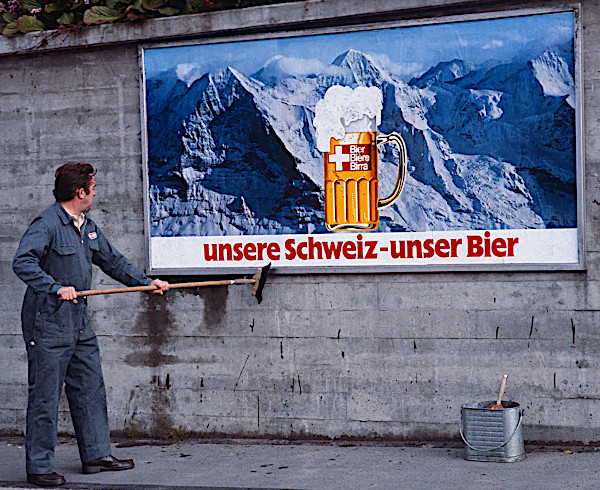
Rebellion against the Beer Cartel
The consequence of years of the beer cartel was a lack of innovation; all beers were brewed to the same recipe and all tasted the same. Eventually the demand for Swiss beer collapsed in the mid-1970s, resulting in more than 250,000 foreign workers having to leave the country; the breweries entered a sustained downward spiral.
The peak output of 5 million hectolitres of beer achieved in 1971 would never be reached again. Even 50 years later, brewery output was just on 3.4 million hectolitres.

Graph : beer production in Switzerland 1940-2016
The cartel came under increased criticism and push-back. In 1974, Basel physician Hans Jakob Nidecker acquired the oldest brewery-restaurant in Switzerland, the Fischerstube Restaurant, and planned to serve the popular Warteck beer brewed in his neighborhood. The beer cartel, however, tried to force him to source beer from a different brewery. Unwilling to comply, Nidecker decided to brew his own beer — a bold move that laid the foundation for the Swiss craft beer movement.
It was not only mavericks like Nidecker that criticised the cartel. Heavyweights in the retail trade joined the criticism - such as the Denner supermarket chain.

“We want to be free like our fathers were… Fight the beer cartel!”. The call to resist, published by Denner supermarket appeared in many daily newspapers on 22 February 1985.
1991 - the cartel collapses and the giant internationals take over
The Swiss beer cartel lasted for 45 years until 1991 when 3 large breweries left, starting a chain reaction that brought about its final demise.
With the fall of the cartel, Switzerland's breweries entered a new era. Faced with lack of price protection, most breweries opted to sell up - small breweries were taken over by larger ones until they themselves were bought up by the even larger international brewery groups - the Dutch Heineken Group and the Danish Carlsberg Breweries.
One small group of 12 regional breweries remained independent and have been able to fight off repreated takeover bids.
Former brewers become property managers
While the multinationals were taking over the big Swiss brands, the former brewery owners found their future elsewhere. By the 21st century, as urbanisation spread around them, the brewery premises that had originally been built on the urban fringes were now in the heart of the cities. Many of the city breweries became property management companies or were taken over by real estate firms - such as the former Hürlimann brewery site in the heart of the city of Zurich - and re-developed for new purposes.
And the Microbrewery-craft beer movement takes off
The end of the cartel also allowed the microbrewery movement to boom from a handful in the 1990s to 1,278 today. Many of these new players are financed by their own beer-drinking patrons who purchase shares in these start-up companies.
Although still tiny as a percentage of the Swiss beer drinking market, there is a growing demand for craft beer being something different to the standardised industrial production of the large breweries whose beers still tend to look and taste the same.
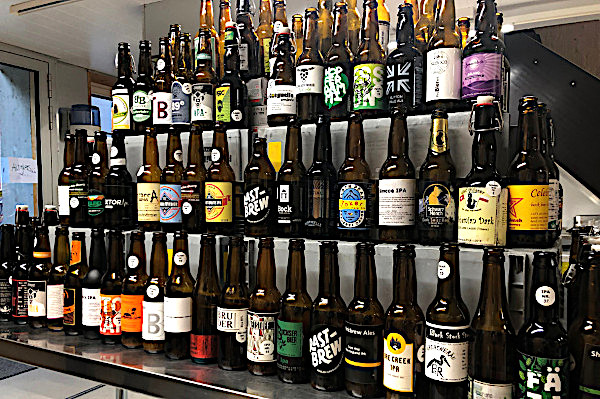
Swiss beer production today
70% of the Swiss beer market is controlled by Heineken (Netherlands) and Carlsberg (Denmark), through their local subsidiaries; 25% is supplied by the independent regional breweries, with over 1,200 micro-beer-makers fighting over the remaining 5% market share.
Lagers are the most popular style, amounting to 75% of total beer consumption with pale lagers being particularly popular; 15% are specialty beers; dark beers amount to 1%
Beer regulation and taxation in Switzerland
- Beer with alcohol above 1.2% abv is subject to federal excise tax which increases with alcohol content
- The age at which beer can be purchased is 16.
- Beer is widely available in outlets such as supermarkets (except the Migros chain), corner shops, and gas stations but the cantons regulate alcohol sales and are free to restrict sales as they see fit.
- Prices for beer in bars are high by international standards, but much lower when purchased at supermarkets.
So what beers should you try when in Switzerland?

These are the beers you are likely to encounter during the tour:
- Feldschlösschen (Basel)
- Cardinal (Montreux, Gruyères, Zermatt)
- Chopfab (St Moritz)
- Valaisanne (Montreux)
- Calanda (St Moritz)
- Eichhof (Lucerne)
- Ruggenbräu (Grindelwald, Lauterbrunnen)
- Zermatt Bier (Zermatt)
Some additional good beers from supermarkets and restaurants:
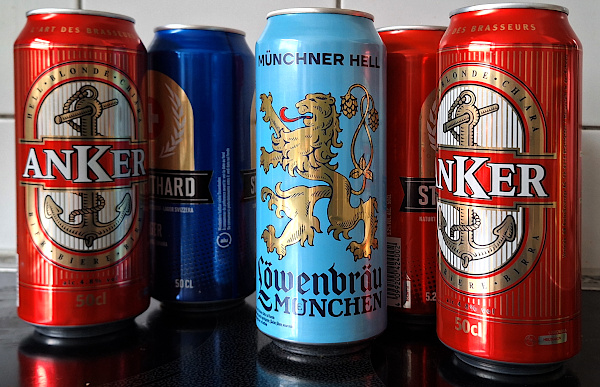
- Anker Lager (in the red can) - Available in COOP at a good price.
- Leuwenbräu Lager (in the blue can) - Available in COOP also at a good price .
- Cardinal (Lager and Premium Lagers)
- Feldschlösschen (Lager and Hopfenperle)
- Chopfab Lager & Ale