
Basic info for the day
- Take fast commuter trains to Switzerland's most northerly city, Schaffhausen, the gateway to the Rhine Falls.
- Take a short boat ride out to the Falls to experience the full power of the rushing water (bring rain protection); afterwards time to walk along the panorama trail for more great photos.
- Return to Schaffhausen for a walk around the old town; learn about its long and interesting history and view its fine medieval and baroque buildings.
- Return to Lucerne - rest of afternoon and evening at leisure.
- Dinner on your own tonight.
Rhine Falls
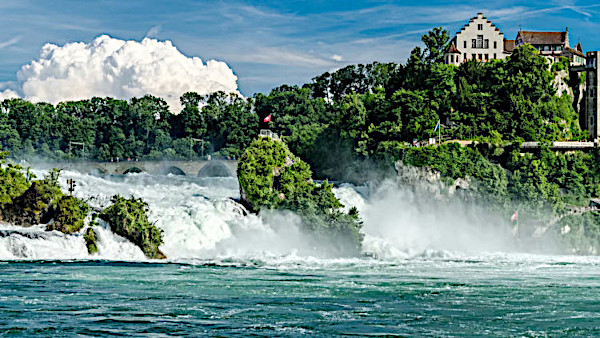
The Rhine Falls are no match to the Niagara Falls, but they are the largest and most powerful waterfalls in the whole of Europe. They measure 150 m (490 ft) wide and 23 m (75 ft) high.
In the summer about 600 cubic meters of water per second splash down to the Rheinfall basin, creating a light mist in the air.
The Falls were formed approx 14,000 to 17,000 years ago, by erosion-resistant rocks narrowing the riverbed. They form a barrier to the free movement of boats along the Rhine River blocking the way from Basel to Lake Constance or vice versa. The Falls are the reason why the city of Schaffhausen was founded where it is - as a transshipment place for goods and people travelling along the Rĥine River.
Up to the 19th century, the force of the water was used for power and a mill and blast furnace for smelting iron ore were located on the north side of the falls. Today, the falls are still under consideration for hydropower projects but the economic value of the falls as a tourist attraction has kept those projects at bay.
Key info on SCHAFFHAUSEN

Location: on the north bank of the Rhine in a finger of Swiss territory surrounded on three sides by Germany; it also encloses an enclave of Germany - a legacy of history that has created a wierd piece of cartography. The city is located at the point on the river where boatmen unloaded their cargoes coming from Lake Constance to move them around the Rhine Falls.
Population: approx 40,000
History: by the Middle Ages, Schaffhausen was a city state with rights to mint its own coins. In 1050 the Benedictine monastery of All Saints was founded which became the centre of the town.
The powers of the monastery were gradually limited; in 1277 the Emperor Rudolf I gave the town a charter of liberties. By 1411 the guilds ruled the city, finally buying its independence in 1418 when the Habsburgs needed money.
Schaffhausen became a full member of the Old Swiss Confederacy in 1501; after the Reformation it became a Protestant town in 1529.
The town was heavily damaged during the Thirty Years' War of the early 17th century by the passage of Swedish (Protestant) and then Bavarian (Roman Catholic) troops. The all-important bridge was burnt down delaying industrial development of the town until the early 19th century.
Bombed by the USA in 2nd World War: on 1 April 1944, Schaffhausen suffered extensive damage in a bombing raid by aircraft of the US Army Air Forces which had strayed from German airspace into neutral Switzerland, due to navigation errors.
Air raid sirens had often sounded in the past, without an actual attack, so many residents ignored the sirens. A total of 40 civilians were killed and many buildings damaged.
The bombs destroyed part of the new Museum of Art in a renovated part of the old Monastery. In an amazing gesture of solidarity, art museums in the rest of the country immediately donated prize works from their collections to re-build the museum's collection.
Schaffhausen today is a major railway junction of the Swiss and German rail networks.
What to see: the old town (Altstadt) has many fine Renaissance and Baroque era buildings decorated with exterior frescos and sculptures and oriel windows. The Munot, a circular keep on the hill above the town built in the late 16th century, has fine views of the river Rhine and the town.