
Milk quality
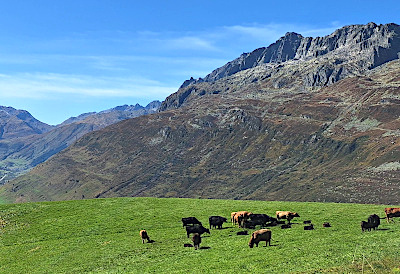
Swiss cows eat grass in summer and hay in winter.
No silage for them if their milk is to be made into cheese, as the resulting high spore content in the milk could lead to butyric acid fermentation, which in turn will spoil the flavour and texture of the end product.
If not made in situ by the herdsmen in the summer months, milk must be delivered to the cheese factory 8 to 12 hrs after milking, otherwise it is regarded as too old.
Most Swiss cheese is made with unpasteurised milk, an additional reason to treat it as soon as possible after milking.
Rule of thumb:
12 litres milk for 1 kg cheese
(1 gallon milk for 1 lb of cheese)
The age-old process of making cheese
Stage 1 : CURDLING PROCESS
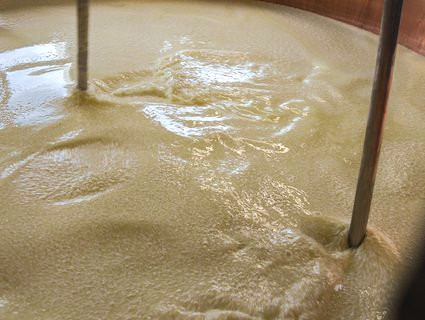
Milk is heated in a vat or cauldron to 32 deg C (90 deg F), stirring constantly.
Once it has reached the required temperature, stirring stops and rennet – a coagulant derived from the stomach lining of calves – and a fermentation culture (yeast) is added. These ingredients act to coagulate the milk, turning it into a jelly-like mass of curds.
Stage 2 : CURD PROCESSING
The curds (smooth pudding-like solids) are cut up and stirred with a “cheese harp” to separate out the whey, and reduce the rest to granules, no bigger than grains of maize.
The mixture is heated during this process to get rid of the liquid.
The size of the granules determines the type of cheese: the larger they are, and the more liquid remains, the softer the final cheese.

Stage 3 : SHAPING & PRESSING
Curd granules are put in round moulds & pressed to get rid of liquid.
Cheese brand labels are applied as their identifying mark.
The cheese is removed from the mould, and immersed in a brine bath (salt content ca. 22%), the recipe for which is a closely guarded secret since it is this brine which first gives the cheese its particular aroma and causes the rind to form.
A soft cheese remains in the bath for about 2 hours;an extra hard variety can stay for up to 72 hrs.

Stage 4 : MATURING PROCESS
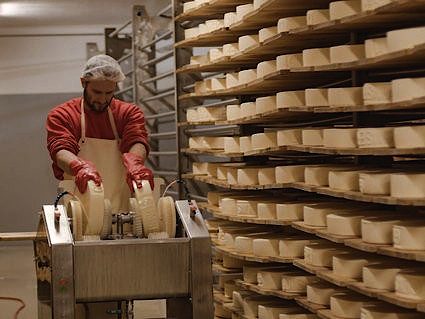
Cheeses are kept in cellars with controlled temperatures and humidity of over 90% depending on type, for natural fermentation to continue.
Cheese wheels are turned and rubbed with brine daily (a process called Affinage).
The maturing time varies according to type and quality of cheese.
- Soft cheeses = a few weeks
- Harder cheeses = several months, and even years.
While maturing, the cheeses are tested for quality using special sample probes and tapping the cheese to detect cracks hidden deep beneath the rind.