

This is a question that has intrigued many people ever since the war ended. Although Switzerland's neutrality had been formally recognised since 1815, would Hitler have respected it, since he had totally disrespected the neutral stances taken by Denmark, Norway, Netherlands, and Belgium?
Hitler's view of the Swiss was most derogatory : “Switzerland possesses the most disgusting and miserable people and political system. The Swiss are the mortal enemies of the new Germany.” (comment made to Mussolini in June 1941)
In August 1942, Hitler further described Switzerland as “a pimple on the face of Europe” and as a country that no longer had a right to exist. Moreover, he denounced the Swiss as “a misbegotten branch of our people.”
For tactical reasons, Hitler made repeated assurances before the outbreak of the War that Germany would respect Swiss neutrality in the event of a military conflict in Europe. In February 1937, he told the Swiss Federal Council president that "at all times, whatever happens, we will respect the inviolability and neutrality of Switzerland". But these were purely political maneuvers intended to lull the Swiss into passiveness while Nazi Germany made plans to take over Switzerland after it had defeated its main enemies.
Operation Tannenbaum
There were many Nazi sympathisers in German-speaking Switzerland, and most Germans in Hitler's leadership circle believed that as Switzerland, as a predominantly Germanic country, would follow the path of Austria and organically fuse with the Third Reich without a shot being fired. Nevertheless, Hitler still ordered an invasion plan to be drawn up. This came to be known as Operation Tannebaum (Fir Tree); various plans were drawn up in 1940 and revised in 1944.
The plan was for a pincer attack by the Nazi forces from Germany and Austria and occupied France joined by Italian forces attacking from the south. In this scenario, a victorious Germany would occupy the area north of the Alps and Italy would get the regions south of the Alps.
The military aim was to gain control of Switzerland's industrial lowlands and preventing a Swiss retreat into the mountain fortresses. The Alpine rail tunnels, vital links between Germany and Italy, had to be captured before the Swiss destroyed them.
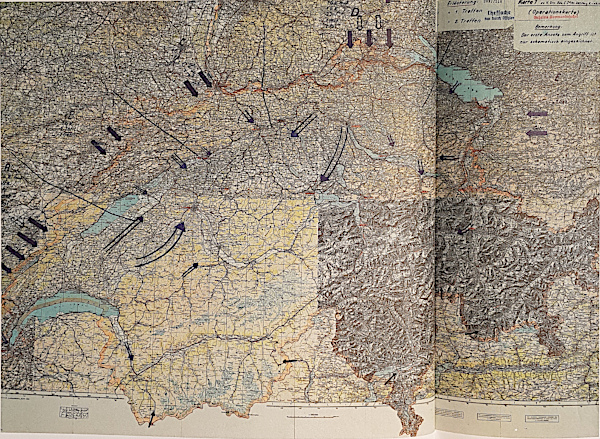
Operation Tannenbaum map (Oct 1940) from the German military archives. The Germans would invade from the north , east and west (blue arrows) and Italians from the south (small black arrows). Bold arrows show the first wave, hollow ones the second.
The original plan called for 21 German divisions, but that figure was downsized to 11 German divisions invading from the north, north-east and north-west, and 15 Italian divisions entering from the south, using between 300,000 and 500,000 soldiers.
Heinrich Himmler also lined up a number of candidates for the position of Reichskommissar (Commissioner of the Reich) for the occupied Swiss territory.

Invasion plan for Switzerland, dated 1940
Yet Hitler never ordered the invasion to go ahead. Why?
Was it because of the natural defences provided by geography and the Swiss National Redoubt strategy?
During peacetime Switzerland does not have a General in charge of the army; it only elects one when needed. So in Sept 1939, as Switzerland braced itself for invasion, it was time to choose a General. An experienced officer, Henri Guisan, was chosen. Together with his senior officers he devised the "National Redoubt" strategy whereby the main army would retreat to bunker-fortresses in the mountains and wage protracted guerilla warfare; the strategic Alpine passes would be destroyed first thereby removing one of the main reasons to occupy the country.
The government ordered a general mobilization and in just 3 days over 430,000 combat troops and 210,000 support troops, were mobilized. After France was invaded in 1940, the conscription age was increased to 60 bringing the strength up to 800,000 men.
In 1940, with the country completely surrounded by Axis powers, General Guisan declared that there would be no surrender; the Swiss would fight to the last man if necessary from highly fortified positions in the Alps. The frontier trrops would delay the invading forces long enough for the main army to reach the mountain fortresses, stocked with enough food and ammo to last for months.
Guisan's Redoubt Strategy was never put to the test as the invasion never came. Historians are divided on how effective it would have been. Certainly its existence was well-known to the German High Command and probably enough for the generals to divert Hitler's attention to an invasion of Russia instead. They realised there would have been little strategic gain in conquering Switzerland and an invasion of the country was not worth the investment in manpower and materials.

Was it because Switzerland was far too useful to Hitler as an independent country?
There was actually little to gain for Germany by invading Switzerland since Germany was Switzerland's main trading partner before and during the war. Germany enjoyed the benefits of Switzerland's industrial output for important war materials, such as ball-bearings, and could transport its goods through the Swiss Alpine railway passes to its ally, Italy.
Also, for Germany to be able to pay its suppliers of imported rubber and tungsten, critical for its war machines, it needed a neutral currency as Deutschmarks were not accepted.
The Swiss Franc was the only freely convertable world currency so the Germans could not afford to loose their only way to trade abroad. By not invading Switzerland, Germany was able to keep intact its vital financial connections to the world.