
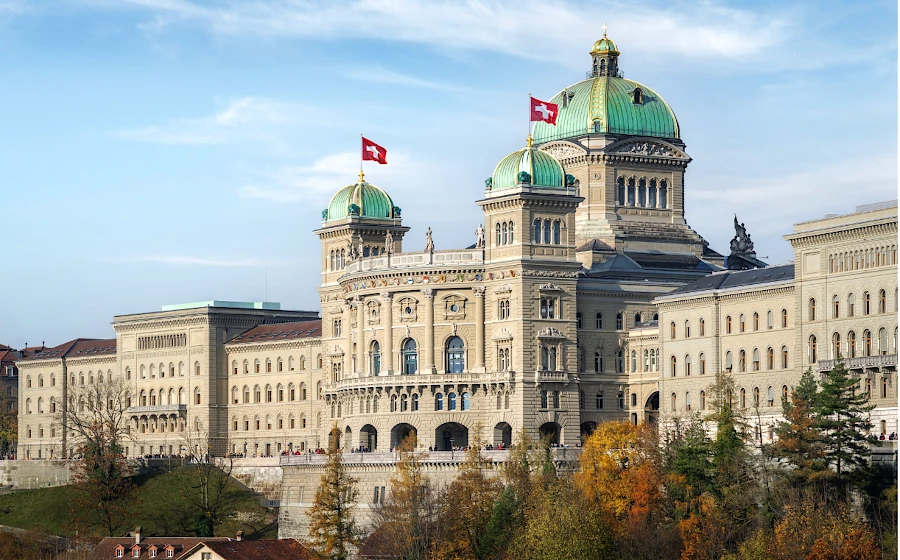
The 2 key principles determining Swiss politics and government:
- Federal system with clear separation of powers - state power is shared between the Federal government, the 26 Cantons and the 2'121 Communities which have broad scope in carrying out their responsibilities, and decision-making is at the lowest possible level.
The separation of powers ensures that power is not concentrated in the hands of any single person or political party. - Direct democracy - Switzerland is the only country in the world to practice Direct Democracy, unlike the 'Representative Democracy' everywhere else.
In Switzerland people vote 3 to 4 times per year; in other countries, people vote every 4 years (if they are lucky)
Benefits of Direct Democracy
- Long-term stability through pragmatic, balanced legislation
- No permanent party in opposition - diverse range of political parties with none having a majority at any level of government
- Politicians are part-time - bring hands-on expertise to debates, are more grounded and accessible to the people
- Politically astute electorate
- Low tax rates
- Cost effective government
- Business-friendly environment
- Excellent, free education
- Trade unions become largely irrelevant
See also: Comparison of benefits of direct democracy over representational democracy
Political authority in the Swiss system of Direct Democracy
The Sovereign = the Electorate
The People have the last word
The electorate hold the politicians, federal counselors and political parties in check; they vote on issues each quarter and can use citizen initiatives to influence, determine or even overturn government decisions.
Every 4 years, the citizens elect members of the:
National Council
(Nationalrat = Parliament or Congress) x 200 members representing the people
and the
Council of states
(Ständerrat = Senate) x 46 members representing the Cantons
Every 4 years, Parliament and Senate sitting together (Federal Assembly) elect the 7 members of the:
Federal Council (Bundesrat)
Counsellors are put forward by their political parties, but once they become a member of the Federal Council, they are expected to rise above party politics and focus on the longterm well-being of the country, and not on short-term political gains for their party.
The Structure of the Government
FEDERAL GOVERNMENT
Switzerland's government is the 7 member Federal Council composed of members from the 4 political parties receiving the most votes - according to the 2:2:2:1 formula ie. 2 seats to the first 3 parties and 1 seat to the 4th party.
The members are elected by the Federal Assembly to serve a four-year term of office and cannot be removed in that time. They can be re-elected any number of times and normally they remain in office until they choose not to stand again for election. This has resulted in one of the most stable governments worldwide. Since 1848, it has never been renewed entirely at the same time, providing a long-term continuity.
The Chairperson of the Council, or President, is one of the 7 Council members who take it in turns to be 'first among equals' for one year but have no powers over and above their 6 colleagues. He/she also acts as the country's ceremonial 'President' during their year as president.
The Council members may have conflicting views and values but always seek a consensus and reach their decisions together and defend the decisions they have taken jointly, even if these decisions are contrary to their own opinions or the position taken by their party.
The Federal Council is assisted in its tasks by the Federal Administration comprising 7 departments - Foreign Affairs, Home Affairs, Justice and Police, Environment-Transport-Energy & Communications, Defence-Civil Protection & Sport, Finance, Economic Affairs-Education & Research; each of these 7 departments have many sub-departments. All are staffed and run by professionally qualified people appointed on the basis of merit.
The National Council (equivalent to Parliament or Congress) decides on the federal budget and federal expenditure may not exceed its income; this is ensured by the "debt brake mechanism".
Key tasks of the Federal Council:
- Preparing legislation to implement the decisions of Parliament
- Strategic planning
- Managing the Federal Administration
- Co-ordination between the 26 cantons.

The 7 members of the Federal Council 2025 and the Federal Chancellor (Head of the Federal Administration)
THE LEGISLATURE
Switzerland has a bicameral parliament called the Federal Assembly, which is composed of 2 Councils with equal powers:
- Council of States (46 seats), also known as the small chamber, represents the 26 cantons.
- National Council (200 seats, split between the cantons based on population), also known as the peoples' chamber, represents the Swiss people.
All items of business are handled both by the National Council and the Council of States. The Councils must agree on all items of business before their decisions can come into force.
Both Councils are responsible for enacting legislation, releasing funding, electing the members of the Federal Council, overseeing the Federal Council and the Federal Administration as well as the federal courts of justice and the Office of the Attorney General of Switzerland.

The National Council chamber
Each member of the National Council represents around 45,000 people; election is based on proportional representation ie. seats held by a canton are distributed among the different political parties based on the votes they receive. This makes it possible for smaller political forces to be represented in the people’s chamber.
Every year a different member is elected by their fellow members as "president" of the National Council and the same in the Council of States.
The size of a canton's population is not a determining factor in its number of seats in the Council of States. Cantons with a small population have the same number of seats as cantons with large poupulations. This system balances out the voting power of the populous cantons in the National Council.

The Council of States chamber
CANTONAL GOVERNMENTS
The 26 Cantons are semi-autonomous states with their own constitutions, governments and law courts.
They implement the requirements of the Federal Constitution, but structure their activities in accordance with their particular needs.
They have broad scope in deciding how to meet their responsibilities in education and vocational training, healthcare, local transport, cultural affairs and police matters.
Each canton levies its own cantonal taxes, and can draw on support from the National Fiscal Equalisation Fund if needed.
To reduce the economic disparities between the cantons (size, urban or rural or mountainous, etc) is the National Fiscal Equalisation system. The federal government and 8 cantons (mainly with large urban populations or attractive company tax rates) are net contributors while the remaining 18 cantons (mainly rural or mountainous) receive equalisation payments (net beneficiaries).
For more information on the Cantons, see Swiss Cantons
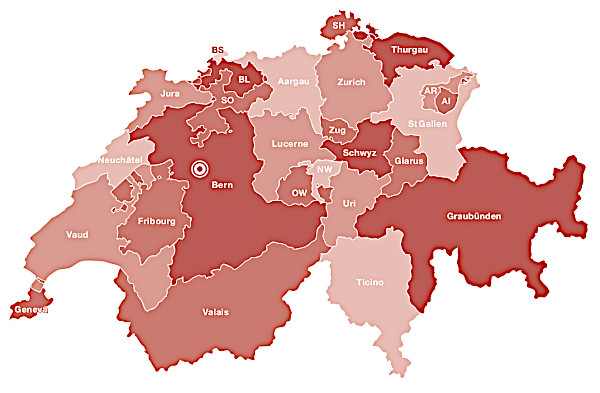
The 26 Cantons
COMMUNITY GOVERNMENTS
At the local level there are 2'121 communities or independent units with their own elected councils made up of part-time politicians.
Responsibilities include local planning, running schools, social welfare, fire service, local facilities.
Each commune levies a communal tax and citizens pay all their taxes to the community where they reside ie. tax is collected at the bottom level.
The citizens determine the tax rates, and expenditure on education, local amenities and local infrastructure.

The 2'121 Communities
For more info on the Swiss Confederation, here is the link to the official
Swiss Government website