
Basic info for the day
- Morning - a highlight of the tour - mountain excursion to the Aiguille du Midi ("Needle at midday") the closest you can get to the summit of Mont-Blanc without hiking or climbing. In 20 minutes the cable car takes you from the centre of Chamonix to an elevation of 3'777 m (12'600 ft) above sea level and delivers some of the most thrilling Alpine views imaginable.
- Afternoon - time at leisure to explore the chic mountain resort of Chamonix. Amble along its cobblestone streets and plaza, enjoying the wonderful restaurants, shopping, or just enjoying a relaxing coffee or gelato at one of the many outdoor cafés.
- For more mountain adventure you can do on your own - take the Montenvers rackrail to the Mer de Glace (Sea of Ice), the largest glacier in France (7km long, 200m deep).
- There is no group dinner tonight so you have an evening free for yourself; check the Vamoos app for restaurant recommendations if needed.
Aiguille du Midi
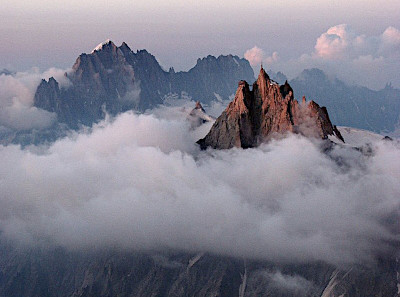
Elevation - 3'842-m (12'605 ft); one of the mountain peaks in the Mont Blanc massif that can be accessed by cable car from Chamonix and which takes visitors close to the Mont Blanc peak itself.
The idea for a cable car to the summit was originally proposed in 1909, but had to wait until 1955 when it was finally realised and was the highest vertical ascent cable car in the world going from 1'035 to 3'842 m (3'396 to 12'605 ft).
There are two sections: from Chamonix to Plan de l'Aiguille at 2'317 m (7'602 ft) and then directly, without any support pillar, to the upper station at 3'777 m; finally an elevator takes visitors to the summit.
Key info CHAMONIX

Elevation - 1'037 m (3'402 ft)
Population - resident population approx. 9'000 expanding many thousands more during the height of the summer and winter seasons.
Twin city with many other ski resorts - Aspen (Colorado); Bariloche (Argentina), Fujiyoshida (Mount Fuji, Japan), Garmisch-Partenkirchen (Germany) among others.
History - First mentioned in 1091 when a Benedictine monastery was established. Became part of the historical territory of the House of Savoy from 12th century. It remained a fairly isolated valley until 18th century when foreign visitors discovered its natural beauty.
1744 - two Englishmen were the first foreign visitors to publish an account of their visit - drew attention to the Mer de Glace and natural wonders of the mountains - attracted scientists and mountaineers.
Horace Bénédict de Saussure (1740-1799) from Geneva - geologist, meteorologist, physicist, mountaineer and Alpine explorer, called the founder of alpinism and modern meteorology - made numerous visits to to the Chamonix valley to collect plant specimens.
In 1760 he offered a reward to the first man to reach the summit of Mont Blanc. In 1786, after many years of attemps, Chamonix doctor, Michel-Gabriel Paccard, and his porter, Jacques Balmat finally reached the summit. In 1787 Saussure himself made the third ascent of the mountain and his achievements did much to attract tourists to the area.
Tourism takes over - 19th century - rapid development of tourist infrastructure and dependence on tourist industry grew. 1909 - opening of 5 km cogwheel railway to Montenvers overlooking the Mer de Glace (Sea of Ice), France's largest glacier.
1916 changed its name from Chamouni to 'Chamonix-Mont-Blanc' to be more tourist attractive.
1924 - host city for the first Winter Olympic Games
1955 - cable car up to Aiguille du Midi (3'842 m/12'600 ft) constructed - the highest vertical ascent cable car in the world at the time.
By mid-20th century - 60'000 tourist beds available and the town hosted 5 million visitors per year.
Chamonix today:- a major resort for both winter and summer sports; hosts world championship events in skiing and ultra running, curling etc.
Savoyard cuisine

Savoyard cooking, the typical food from Chamonix Mont-Blanc, is very similar to that found in the Swiss Alps. Both are based on variations using a base of cheese and potatoes. The key ingredients are produced locally in the summer and are easy to store during long winter months. With a high calorific value they provide a perfect source of fuel for humans working up in the mountains.
Like in Switzerland, Fondue and Raclette are popular, but here are some other local Savoyard specialties to try:
- Pierrade or Pierre chaude - a hot piece of slate on which you cook your own slices of meat at the table.
- Croute savoyarde - a toasted piece of bread soaked in white wine and then baked with melted cheese and possibly mushrooms or tomatoes.
- Tartiflette - potatoes and bacon smothered with melted roblochon cheese.
- Toasted goat's cheese salad with nuts.