
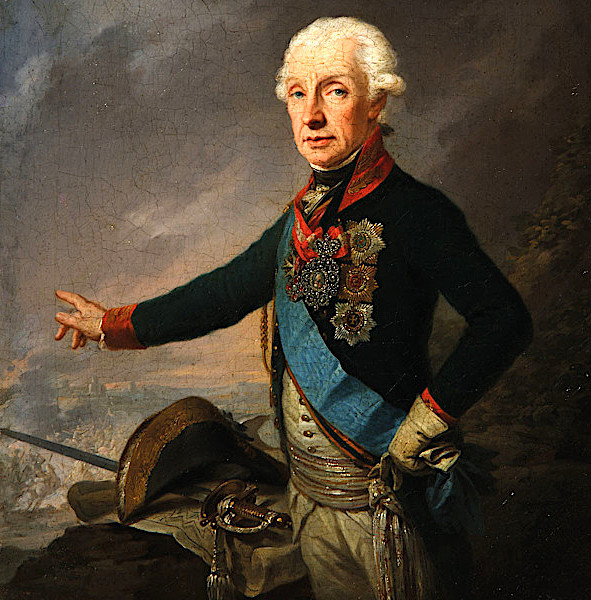
Generalissimo Alexander Suvorov
He participated in 7 big wars, won 60 battles without losing any of them even though on many occasions he was vastly outnumbered by the enemy.
He followed the principles of the “Three Military Arts”:
- Judgement of eye = detect the weakest point of the enemy's defences and use it as focal point of the main attack;
- Speed = swiftness of decision making and implementation, and tactical mobility on the battlefield, and
- Attack = consistent and coordinated actions by well-trained units.
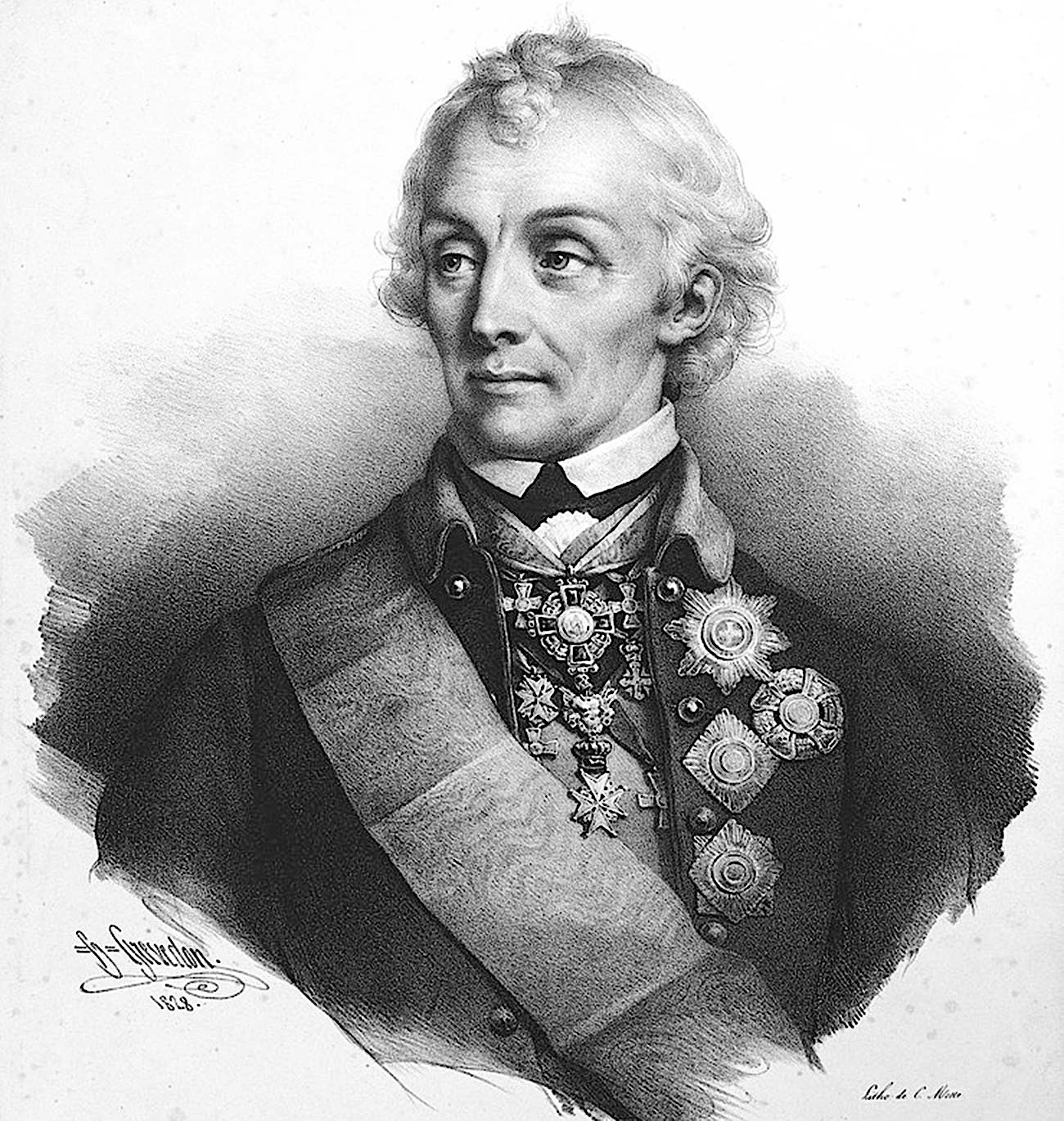
Despite Empress Catherine II showering him with rank and honours, he preferred a simple army life, wearing a simple soldier's uniform, living and eating with his soldiers - a real “soldier's soldier”.
But Catherine's successor Paul I introduced Prussian army ways which Suvorov sharply ridiculed. “Hair powder isn't gunpowder, a ringlet isn't a gun, a plait is no cutlass and I'm not Prussian, but a natural-born Russian.” so in 1796 Tsar Paul exiled him to his country estate … until 1799 when Russia's allies demanded he be reinstated to lead the coalition to drive out Napoleon's forces from Italy.

The year is 1799. War is raging in Europe as Revolutionary French forces invade, conquer and subjugate great swathes of territory.
Austria and Russia form an alliance against France. It is a struggle for influence, power, territory - and the preservation of the old autocratic social order against a new revolutionary system of social equality.
On one side = the existing order of authoritarian hereditary ruler over a society in which a person's social origin determines his or her rights and obligations.
On the other side = revolutionary France's new notion that everyone should have the same rights and obligations.
Switzerland tries to maintain its neutrality but its geographical position means it holds strategically important passes though the Alps over which the warring parties try to gain control.
By 1798 the loosely organized Swiss Confederation cannot withstand the French military pressure and it becomes the "Helvetic Republic" under French occupation.
Russia, Austria and England join forces to counterattack the increasingly dominant France. Austria demands that General Suvorov be brought out of obscure retirement to head the coalition forces in Italy. He inflicts crushing defeats on the French forces in battles at the Adda and Trebbia rivers, and enters Milan in triumph.
He plans to march on Paris, but instead in Sept 1799, he and his 21'000 troops are ordered into Switzerland to join up with the Austrian-Russian forces already there to drive out the French once and for all.

Suvorov and his army make their way from Milan up to the St. Gotthard Pass, facing constant harrassment by French forces sent to delay their advance.

Suvorov's army on the Gotthard Pass
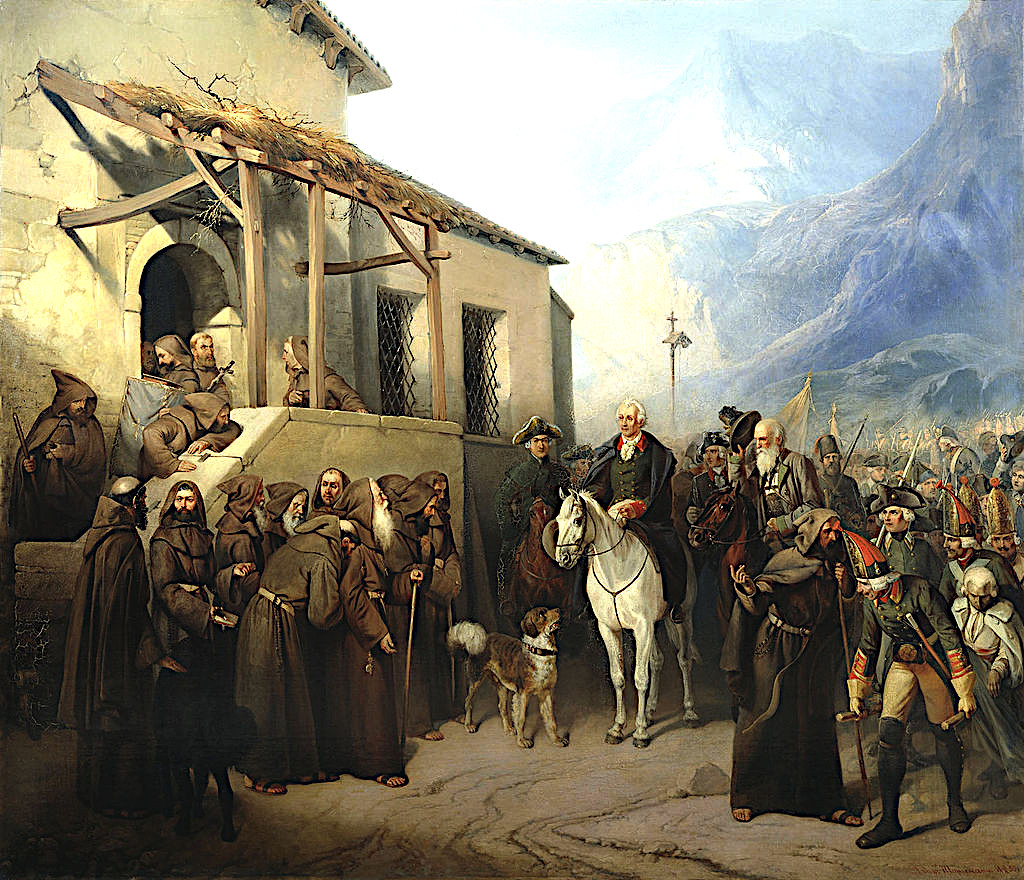
Suvorov arrives at the Gotthard Pass
The local Swiss see Suvorov as a liberator from the French.
Suvorov's forces face the French at the infamous Devil’s Bridge (Teufelsbrücke) which has been destroyed by the enemy. By taking planks from a nearby barn and tying their belts together, the Russians are able to repel the enemy and make a bridge to get themselves across.

Many men lose their lives falling off the mountain. Many horses and much ammunition are also lost.
Just when they think they have achieved the impossible and reach their destination of Altdorf, they hear that the Austrian-Russian forces with which they are supposed to join up, have just been defeated at the 2nd Battle of Zürich.

General André Massena and the victorious French at the 2nd Battle of Zürich (25-26 September 1799)
Now surrounded by an 80'000 strong enemy, short of ammunition and supplies, and with the first snows of winter falling, Suvorov has to extract his army from an apparently hopeless position.
Suvorov decides to march his army over the Kinzig Pass (2'000 m/6'800 ft) to the Muotathal.
There they face another battle with the French but the French are routed by the speed of Suvarov's counterattack and General Massena barely escapes capture.

The Russians continue over the Pragel Pass (1'600 m/5'300 ft) to Glarus, down the Linth Valley and then over the Panix Pass (2'400 m/7'800 ft) to reach Ilanz and on to Chur and over to Austrian territory via the St Luzisteig Pass.
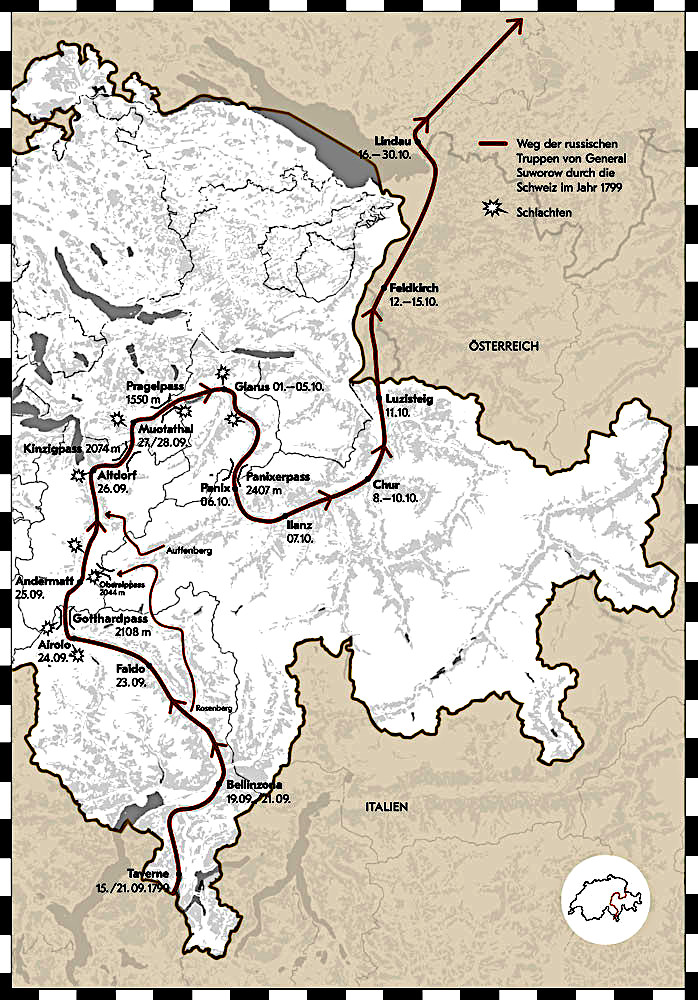
Suvorov's route through Switzerland
After an epic 21-day, 300-km-long march, and scaling heights of up to 2,400 m over 5 snowy mountain passes, 15'000 remaining Russian soldiers finally reached coalition-held territory - no wonder Suvorov is seen as a hero!
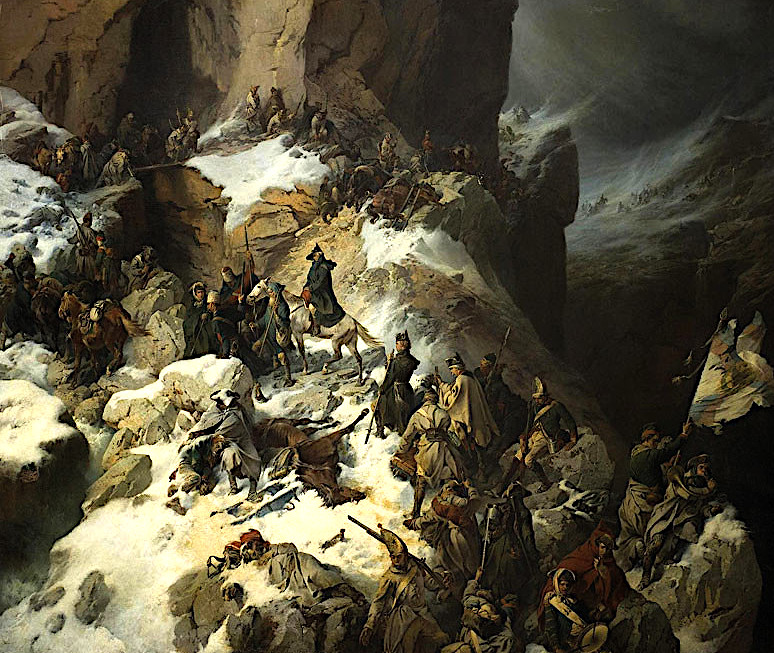
Suvorov's army crossing the Panix Pass in winter
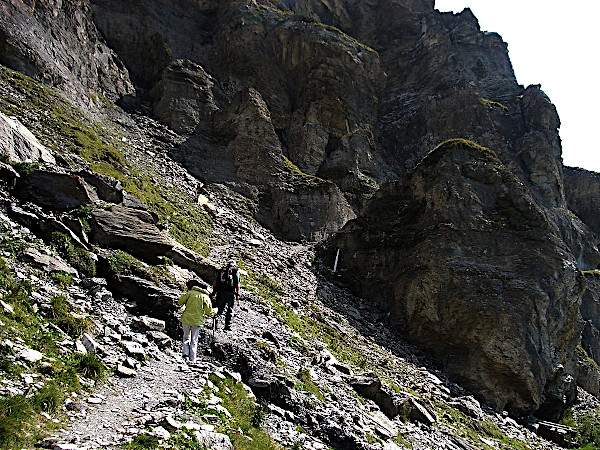
Panix Pass today - today still only a footpath and mule track!
Consequences for Switzerland
The effects of the war on the local Swiss inhabitants were catastrophic.
Farmers' livestock were stolen or slaughtered, and soldiers plundered forage for their own pack animals.
The food supplies of the people were exhausted even before the onset of winter. The soldiers looted valuables and church property.
Devastation, cold and hunger dominated central Switzerland. From then on, the local population lived in poverty for many years and only very slowly recovered from the consequences of the campaigns of foreign warring sides.

French & Russian soldiers fight over a Swiss cow
Suvorov returned exhausted but triumphant to St Petersburg but died shortly afterwards in May 1800, never having fulfilled his greatest ambition - to meet Napoleon Bonaparte on the battlefield.
Suvorov's grave with his simple self-chosen inscription:
"Here lies Suvorov"

Suvorov or Napoleon - who was the greatest?

Although Suvorov and Napoleon undoubtedly knew about each other, they never faced each other on the battlefield.
In a letter to a colleague, Suvorov described Napoleon Bonaparte:
“He is a hero, he is a spectacular warrior, he is a magician. He vanquishes both nature and men… ..... Unperturbed by numbers, he attacks his adversaries everywhere and smashes them totally. He knows the invincible power of pressing home an attack..... He moves his regiment, fights and defeats following his own will. Here is my conclusion: while the General Bonaparte conserves the presence of spirit, he will be victorious. He has received great military talents. However, if, unluckily for him, he will throw himself in political whirlwind, he will perish."
Napoleon Bonaparte was more reticent in his praise of Suvorov, asserting that:
"Suvorov has the heart but not the mind of a good commander."
The jury of military historians is still out and there is no consensus in sight!
The Suvorov Monument at the Devil's Bridge

In 1899 on the centenary of Suvorov's battle in Switzerland, the Russian tsarist government asked Switzerland for permission to erect a monument to their Generalissimo. The gorge near the Devil's Bridge was considered the most suitable place for it.
The memorial is a stone cross carved into the rock in tribute to the memory of a great commander and the soldiers who died and survived in the terrible battle. Currently, the rock with the monument and the road leading to them are owned by the Russian Federation.

Quotations attributed to Suvorov
"Fight the enemy with the weapons he lacks."
"What is difficult in training will become easy in a battle"
"One minute can decide the outcome of the battle, one hour - the outcome of the campaign, and one day - the fate of the country."
"The more comfort, the less courage there is."
"A strong pursuit, give no time for the enemy to think, take advantage of victory, uproot him, cut off his escape route. "
"Train hard, fight easy."
"Judgment of eye, speed and attack are the basis of victory."
"Win with ability, not with numbers. "
“As long as the enemy fights he must be beaten relentlessly, but a defeated enemy and especially the civilian population must be treated generously."
"He who is afraid is half beaten."
"When the enemy is driven back, we have failed, and when he is cut off, encircled and dispersed, we have succeeded."