Swiss info

Animals of the Alps


Chamois (Gämse)

Gämse

By mid-19th century the chamois was nearly extinct in the Swiss Alps and protecting the it was one of the main motivations for the creation of the Swiss National Park. That and a new law to regulate hunting have allowed numbers to increase to around 95,000. And now they can be hunted, but with strict limits.


The chamois is particularly well adapted to its habitat.

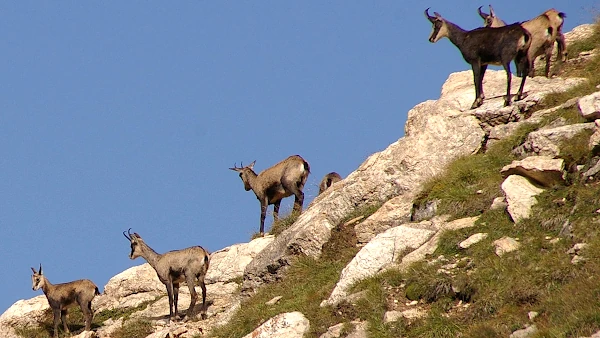
Chamois inhabit cliffs, forests and pastures. They remain in the upper regions during the winter where they find food on snow-free crests or by scratching in the snow.

When in danger, they withdraw to cliffs, across rocky slopes, or hide in mountain pine forests. Their hooves greatly contribute to their agility to leap from rock to rock. Hard on the edges, but smooth like leather in the centre, they afford a good grip.

Detection of an unknown scent is more likely to cause a chamois to flee than the sighting of something unusual.

Both male and female chamois have similar horns although the horns of the female are more slender and not so curved as those of the male. Chamois horns grow continually and are not shed.
Chamois

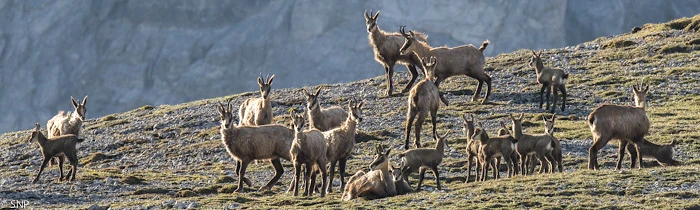
Female chamois live with their young, in herds, throughout the year.

They give birth in June and their kids follow their mothers everywhere from the moment of birth. During their first summer, the young chamois quickly have to learn how to survive in the rocky mountainous terrain.

The hooves of the chamois greatly contribute to its agility whe moving around in rocky terrain. Hard on the edges, but smooth like leather in the centre, they afford a good grip. Early mountain shoes were similarly made.

Male chamois are solitary and remain in the same territory all year round.

The habitat of the chamois is not only mountainous. They are also found in mountain forests, where there is plentiful food and shelter. Chamois that live in the forests often have a layer of resin on their horns.
Chamois

Male chamois are solitary and remain in the same territory all year round.

A fully grown male grows up to 1.3 metres (4.3 feet) in length, and weighs 50kg (110lb); its horns are ca. 17cm (7 in) long and bend back into a hook at the end. Males have two dark stripes running down the face. They also have a mane on their back, which reaches a length of 15–20cm (6–8 inches) in winter. They can make the hairs of this mane stick up, which makes the animal appear bigger and gives it an advantage in social interaction.

As well as sight and sound, smell also plays an important role in communication between chamois. By rubbing its horns on branches and twigs the male deposits a musk-smelling secretion from glands situated behind the horns, in particular during the rutting season. This smell permits individual recognition by other males.

During the annual rutting season in November, brutal combats between rival males take place. Male chamois pursue each other intensively. Their sharply pointed horns can lead to fatal injuries of one or both combatants.
Chamois

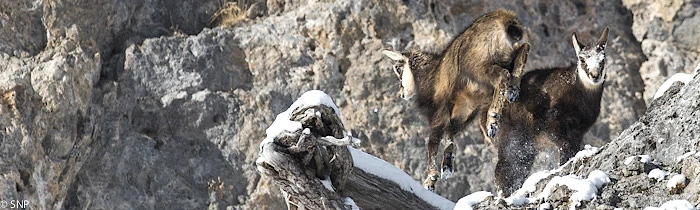
Their main threat to existence is chamois-blindness.

This is a form of conjunctivitis, caused by a virus. The eyes of animals affected become clouded, and they may eventually become totally blind. Before it can recover, the animal will almost certainly starve to death or fall off a cliff.


Ibex (Steinbok)

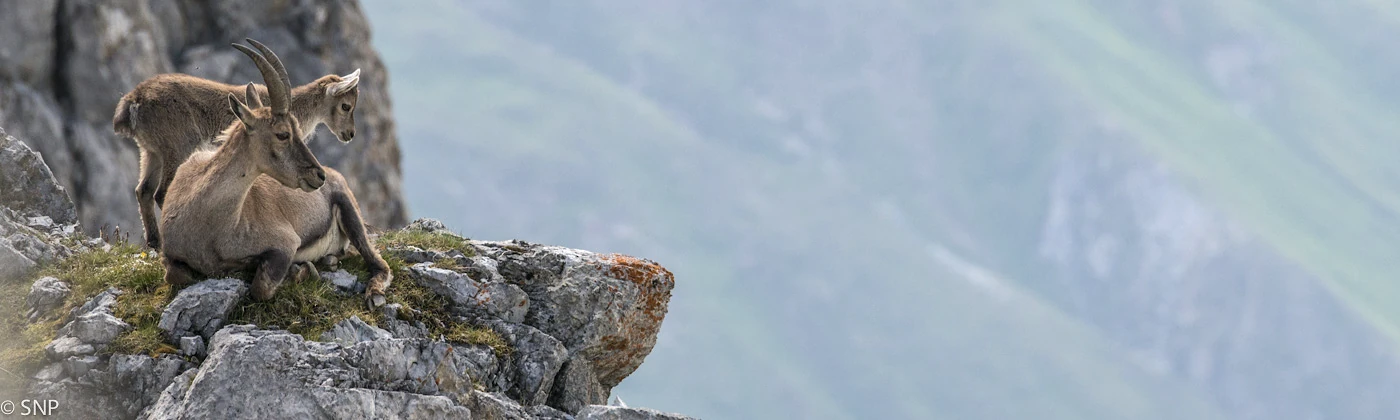
Steinbok

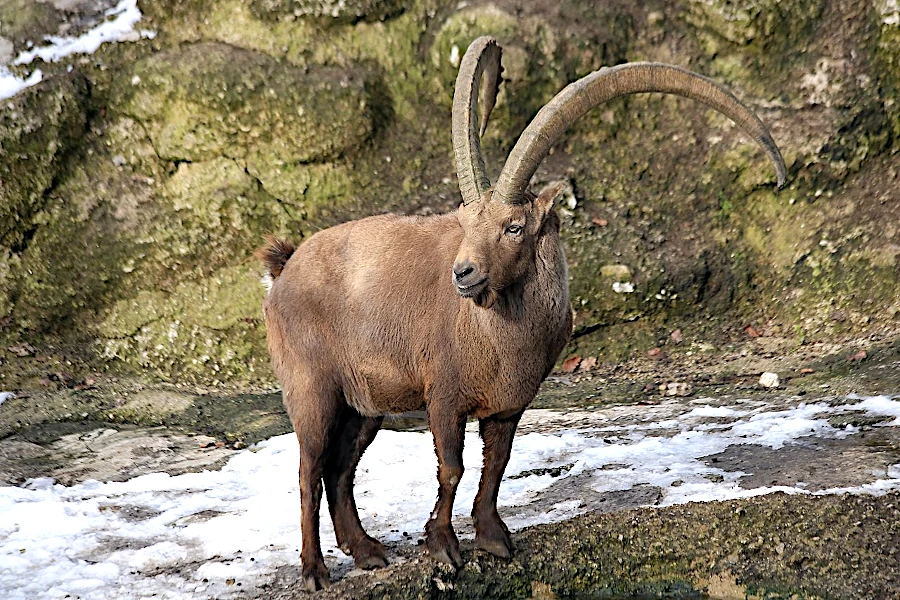
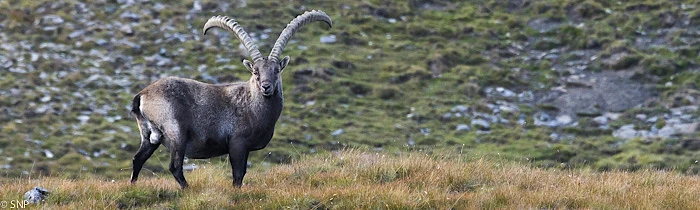
The Steinbok (ibex) male can weigh up to 100kg (220lb), and stands up to 1 meter (over 3 feet) high at the shoulder.


The ibex was much prized in former times for its medicinal powers. Almost all its body parts, and even its dung, were used for traditional cures for all manner of diseases. So by the beginning of the 19th century, ibex in Switzerland had been hunted to extinction.

At the end of the 19th century, ibex were reintroduced to Canton Graubünden when a breeding pair from a small herd belonging to the Italian king Vittorio Emmanuele III was poached and secretly smuggled into Switzerland. Since then their numbers have grown to approx. 15,000 animals in different parts of Switzerland, mainly in Graubünden, Canton Bern and Canton Valais.

The word for ibex in Romansch is «macun» and there are indeed ibex living in the region called Macun situated above Lavin – hence its name. Since 1 August 2000 the ibex in that region are also inhabitants of the National Park.

Steinbok

Ibex live in separate male and female herds of 10 to 30 individuals. 

A male ibex can weigh up to 90kg (200lb), and stands up to 1 m (3 ft) tall at the shoulder. It has two large curved horns with horizontal ridges which grow throughout the animal's life. The age of the animal can be determined by the number of ridges: in general it grows 2 ridges in 1 year. The horns can grow up to 1 m in length and weigh more than 10kg (22lb).

In herds of males the size of the horns is a sign of individual strength. In August and during the rutting season in December the strongest males demonstrate their dominance.

Steinbok

Female ibex are very attentive and keep a close watch on their surroundings.

Female ibex live in small herds with other females and young ibex. The young are born in June and have a warm, woolly coat. They grow up within the protection of the herd.

The horns of the female ibex are smaller than those of the male. The annual rings are closer together and it is not as easy to tell their age. A female ibex can reach up to 24 years of age.

Steinbok

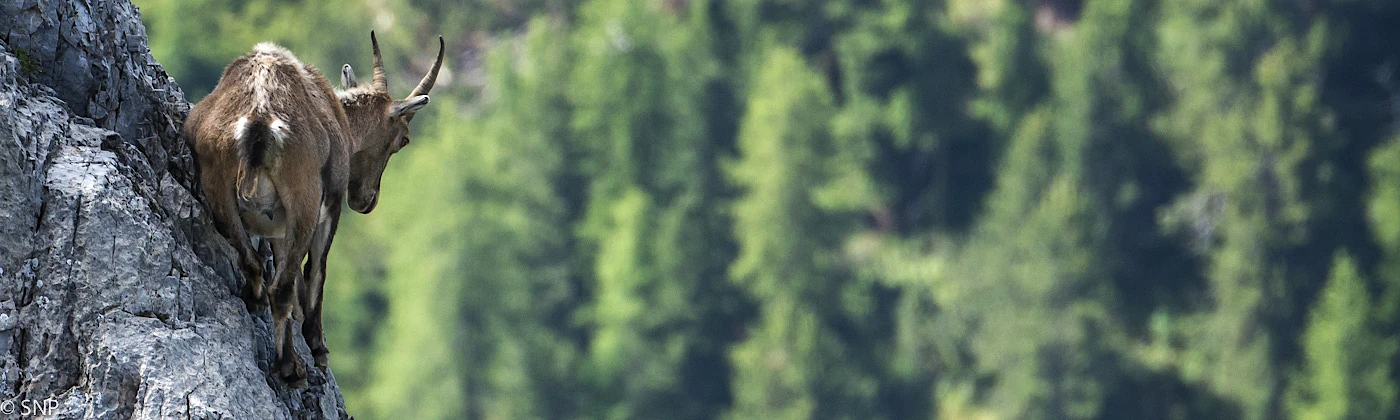
Ibex live on mountainsides above the tree line and only very rarely descend into the forests.

They have hooves well adapted to the habitat with a hard rim surrounding a soft inner part, enabling it to grip the rock and gain a good foothold even in the steepest places. The back legs are longer than the front ones. The are excellent jumpers, able to leap several meters upwards and forwards from a standing position.

How an ibex is able to optically assess the quality of its landing place remains a mystery. The precision and certainty with which they land is remarkable.

Ibex feed on alpine herbs and grasses, as well as - in winter - bushes, roots and lichens.

Steinbok


Red deer (Rothirsch)

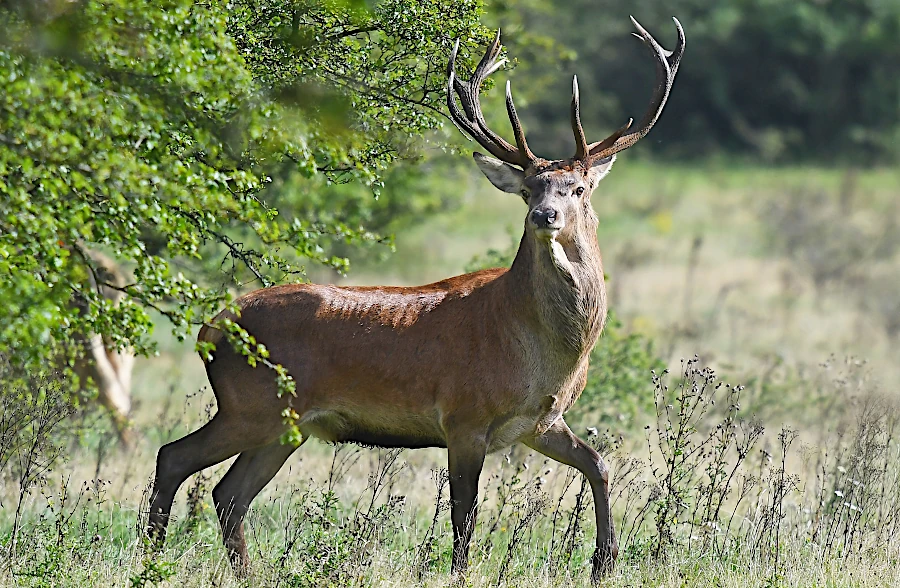
Red deer

By mid-19th century these magnificent animals had been hunted out from the Swiss Alps; around 50 years later they reappeared having quietly migrated in from other areas.


The main sanctuary of the red deer is in the Swiss National Park where around 2,000 red deer live during the five summer months. After the rut in mid-October they migrate to the sunny slopes of the main valleys of the Engadine, Val Müstair and Vinschgau.

Red deer

Red deer hinds generally live together with the female herd, including their calves and young animals born the previous year. In their first year young deer, or fawns, have no antlers. Hinds are more closely attached to their female young than their male offspring. Stag calves remain with the herd for maximum two years.

Red deer males live in male herds except during the rutting season

A stag’s antlers serve both to impress and to fight. Formed of bone, they are grown annually, between March and July, and are cast off at the end of winter. Stags carry antlers from their second year onwards to the end of their life.

During growth the new antlers are covered by the “velvet” - a soft, blood-filled bone-forming tissue. Once the antlers have grown to full-size, the velvet is shed, often assisted by fraying (rubbing against trees and bushes). The brownish colour of the antlers is the result of staining by blood and earth.

Red deer

During the rut fierce fights take place between stags claiming their hinds. The so-called “master” stags vigourously defend their harems against “intruders”.

These fights often cause injury or, more rarely, death. The winner is usually the fitter of the two stags, not necessarily the one with the most impressive antlers.

Red deer


Marmot (Murmeltier)

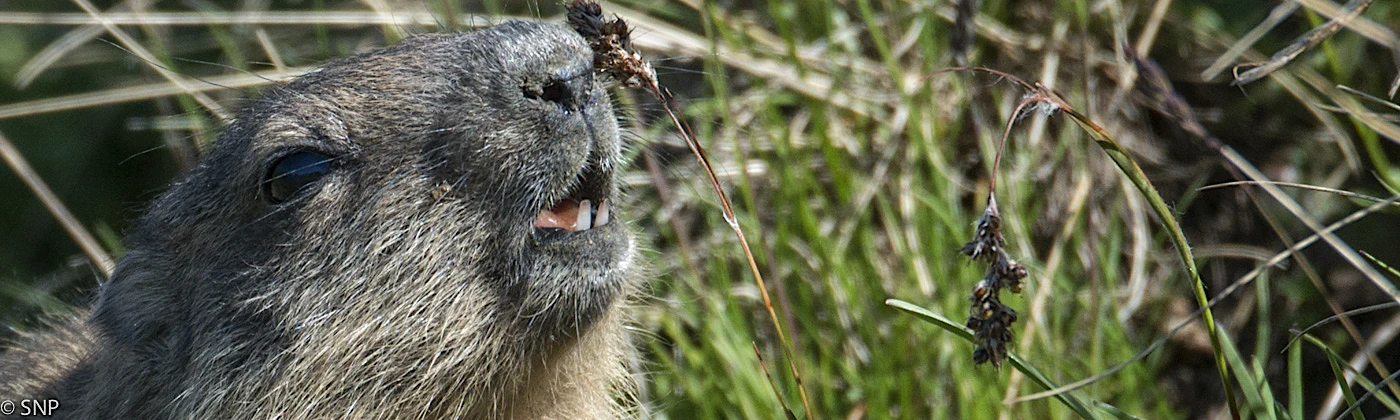
Marmots

The largest species of the Sciuridae (squirrel family), marmots live in the high Alps at altitudes from 800 to 3,000 meters on open Alpine meadows.


Marmots have a distinct rodent-like look with large front teeth, and a thick fur coat. They are excellent diggers and live in burrows deep underground which can be up to 20m (60 ft) long and ip to 3m (6 ft) deep underground. Often, different burrows are used for summer and winter.

They are only seen in the summer, and more often heard as they emit piercing alarm calls when danger, espcially from birds of prey, threatens.

Marmot

Family life and social contact

Marmots live in family groups of up to 15 members, making labyrinthine burrows in open meadows. When they emerge to feed– on grasses and other plants– one of them always stands guard.

Families are generally made up of one adult male and one female and several young with both parents caring for the offspring. Females do not carry young every year, so there is not a new generation in a family every year.

They recognize each other through scent glands in the cheeks, and social contact is important to them. Individuals that do not belong to the family are chased away.

Their predators are birds of prey, lynx and foxes. When the look-out whistles, every marmot in the group instantly dives underground for safety

Marmot

Marmots hibernate for 7-8 months of the year

At the end of September the marmots retreat to well-lined winter burrows and goes into hibernation. During hibernation their body temperature drops to 5ºC/41ºF and they neither eat nor drink. They wake as the snow is thawing.


Alpine Salamander

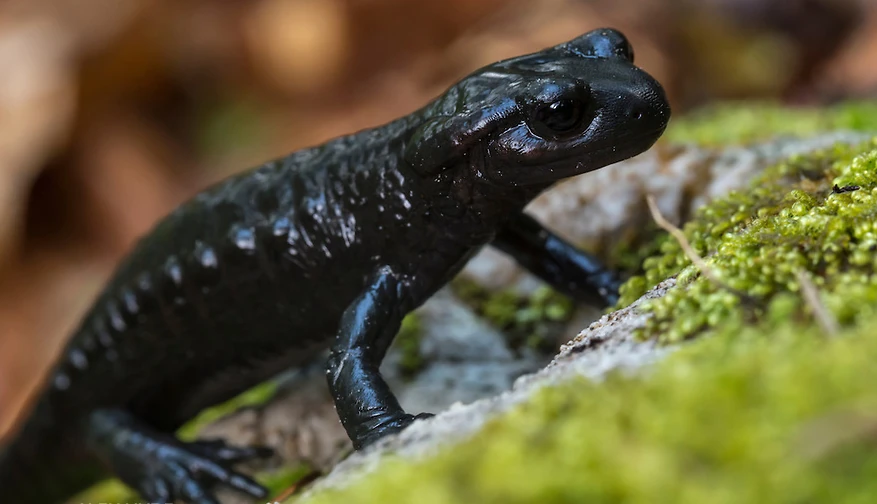
Salamander

The largest species of the Sciuridae (squirrel family), marmots live in the high Alps at altitudes from 800 to 3,000 meters on open Alpine meadows.


The Alpine Salamander holds 2 records due to adaptations it has developed to cope with high-altitude habitat:

  • it is the only European amphibian to give birth to live young (usually two of them)
  • in the case of animals living above 1,400 meters (4,600 feet), they may remain inside the mother for three years – a far longer gestation period than even the elephant, which takes up to 760 days.

In another adaptation to its habitat, it often hibernates en masse. The advantage to the salamander from this adaptation is that the offspring are protected from predators and also from the danger faced by tadpoles of having their pond frozen or dried out.

The Alpine salamander lives in damp places, such as mountain forests, up to heights of 3,000 m (10,000 ft).

It is completely black and grows to a length of 16cm (6 in). It feeds mainly off beetles, spiders and centipedes.


European brown bear

European brown bear

After Brown Bears in the Swiss Alps were hunted to extinction, the last bear being shot in 1904, it was totally extinct until recently when brown bears have started to migrate from Italy and Slovenia into Switzerland. The bears are now collared and tracked to try to avoid human-bear contact.

Other animals to be found in the Swiss Alps in small quantities include:

  • Mountain Hare
  • Fox
  • Lynx
  • Wolf