
Basic info for the day
- Morning - return to Interlaken Ost train station in order to transfer to the GoldenPass Express with its unique gauge-changing technology. Travel through picture-postcard rolling hills, green pastures, grazing cows, wooden chalets and picturesque villages before arriving at the "Swiss Riviera" resort town of Montreux on the eastern shore of Lake Geneva
- 2-hr stop for lunch in Montreux; Dave offers an exclusive "Montreux Music Walk" for those interested in music especially of the 1970s and 1980s.
- Afternoon - continue the journey south next to the Rhone River as far as Martigny and transfer to the Mont Blanc Express, a meter-gauge cogwheel built 1899-1906, traversing steep gradients and yet more picturesque scenery.
- After crossing the border into France, a short ride takes us to the resort town of Chamonix at the base of Mont Blanc, the highest peak in Western Europe, and venue for the 1st Winter Olympic Games in 1924 (more info on Chamonix under Day 6).
- Dinner at the hotel.
GoldenPass Express
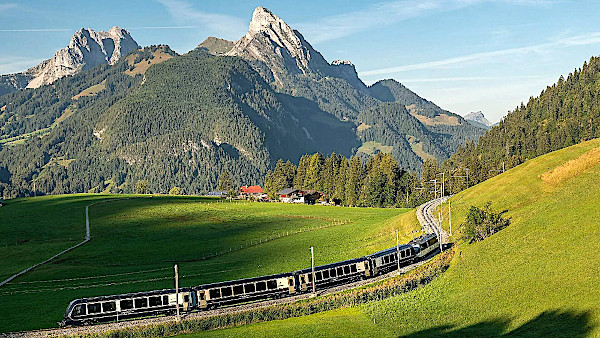
Since Dec 2022 the train runs from Interlaken all the way to Montreux, finally linking the Bernese Alps region to Lake Geneva without the need to change trains.
The idea to link the 19th century tourist hotspots of Lake Geneva with Gstaad and Lake Brienz was first proposed in 1873, but differences in railway gauges and electricity systems prevented this from happening.
140 years later, using latest generation variable gauge technology, the new direct train overcomes the challenges of 2 different track gauges in both height and width, and variances in voltage requirements. Previously travellers had to change trains at Zweisimmen, now they remain seated in the train as it slows down to 15 km/h and the wheelbase expands or contracts to fit the new gauge as the train passes over the gauge-changing mechanism.
The complex wheel structures beneath each carriage can also raise the body height to meet the higher platforms of the stations along the standard gauge line, or vice versa along the narrow gauge route, so elevating or lowering the coach from 35cm to 55cm (13.5 to 21.5 inches) in a few seconds, making this a world-first feature.
Montreux
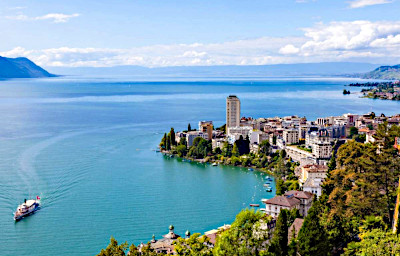
Location - eastern shore of Lake Geneva in view of the French Alps across the lake. Capital of the "Swiss Riviera"
Population - 26'000; 44% of residents are foreigners
Climate - exceptionally mild; plants associated with the Mediterranean and tropics (like cypresses and palm trees) grow well here.
Belle Epoque - city gained fame as a resort in 18-19th centuries - many old "belle époque" style hotels and buildings in French style
Centre for private education - 4 private international boarding schools and 3 private hotel schools located in or close to the city
Jazz Festival - since 1967 hosts the annual Montreux Jazz Festival at beginning of July; has since expanded to include pop and rock music.
Notable residents past and present - Charlie Chaplin, James Mason, Ernest Hemingway, Noel Coward, Zelda Fitzgerald, Graham Greene, Vladimir Nobokov, Igor Stravinsky, Tchaikovsky, David Bowie, Freddie Mercury, Shania Twain
Mont Blanc Express
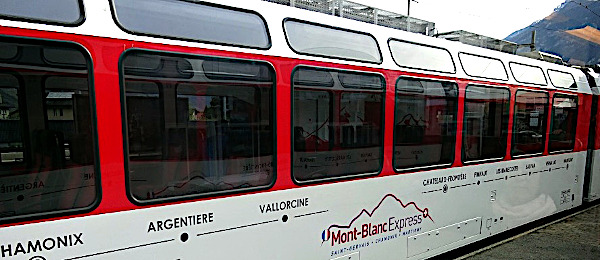
Leaving Martigny, the train traverses the wild Trient Gorge and climbs up mountain heights accompanied by views of rushing waterfalls and majestic mountain crags rising in the background.
The scenery shifts from shady thick forests, passing through cozy little Alpine villages crossing the border into France and finally passing below the magnificent glacier of Mont Blanc, Europe’s highest peak, before arriving at Chamonix-Mont Blanc station 1½ hours later.
Mont Blanc
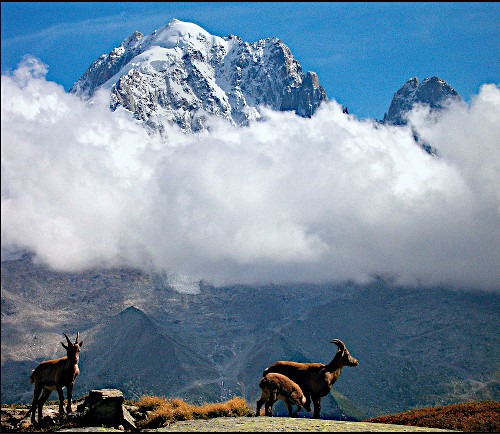
Mont Blanc peak (altitude 4'807 m/15'771 ft) is part of the Mont Blanc mountain massif that includes 10 other peaks. The massif lies on the border between France and Switzerland with the highest point just in France. It extends southwestward from Martigny, Switzerland, for about 40 kms (25 mi) and has a maximum width of 16 km (10 mi).
The whole Alps have been hit hard by the climate crisis and Mont Blanc lost 10% of its ice in just 2 years (2022 and 2023); since 1950 it has lost 50% of its ice.
Melting ice make the upper regions of the peaks unstable. Melting permafrost leads to instable slopes and crumbling rocks which cause many rockfalls.
Mountaineering as a "sport" was born when a young scientist from Geneva, Horace-Bénédict de Saussure, on a visit to Chamonix in 1760, determined that he would be the first to climb to the top of Mont Blanc, or be responsible for it being climbed, and he offered prize money for the first ascent. It was not until 1786, more than 25 years later, that his prize money was claimed by local Chamonix doctor, Michel-Gabriel Paccard, and his porter, Jacques Balmat. A year later de Saussure himself climbed to the summit of Mont Blanc.
Today around 20,000 people attempt the climb each year; many are novices; an average of 10 climbers per year die on Mont Blanc itself.
Nowdays to discourage climbing, a charge of $15'000 is levied - $10'000 for rescue & $5'000 for the funeral...