Basic info for the day
- The last highlight of the tour comes on this last full day of the tour - a trip by cable-car and cogwheel train up to the 3'454m (11’333ft) Jungfraujoch complex, completed in 1912, built inside and on the saddle between the Mönch and Jungfrau peaks.
- Europe's largest glacier, the Aletsch glacier, spreads out below you, surrounded by mountains, snow, and ice as far as you can see, allowing you to get some last photos of snow-covered Alpine vistas.
- Afterwards return to the Eigergletscher railway stop for our “final day” group lunch at a restaurant with magnificent views of (what remains of) the Eiger glacier. After lunch return to Zürich airport via Lauterbrunnen and Bern.
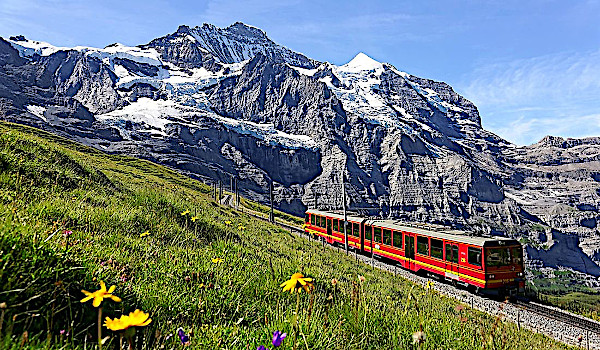
The Jungfrau Cogwheel Railway
The tracks were laid in stages between 1899 and 1912 up to the highest railway station in Europe at 3'454 m (11','333 ft); that record still stands today.
The line runs for 9 kms (5.6 mi) from Kleine Scheidegg, 6,5 kms (4 mi) of which is in a tunnel inside the Eiger to the saddle between the Jungfrau and Mönch peaks. It took 16 years to build (twice as long as estimated), and cost SFr 15 million, (more than double the original budget).
The railway was the brainchild of Swiss textile industrialist Adolf Guyer-Zeller (1839-1899). He got the inspiration to build the Jungfrau railway and tunnel while on holiday in nearby Mürren, sketching a plan in his notebook in August 1893. A man of action, he applied for the concession to build the railway just 4 months later.
The Jungfrau Railway was conceived in the midst of a tourist railway craze. Guyer-Zeller was motivated by the immense financial success of other tourist railway lines near Lucerne that brought immediate high returns on investment.
Not everyone agreed that laying railtracks and blasting tunnels in the Alps for tourists was a worthwhile pursuit. In 1912 the Swiss League for the Defence of Natural Beauty and the Swiss Heritage Society petitioned the government "to put a stop to this destructive folly and save for our descendants what remains of our heritage of beauty”
The mountain railway building boom was killed by the First World War, after which new kinds of clientele had to be found - a process still ongoing to this day.
Lauberhorn Downhill Ski Race, Wengen
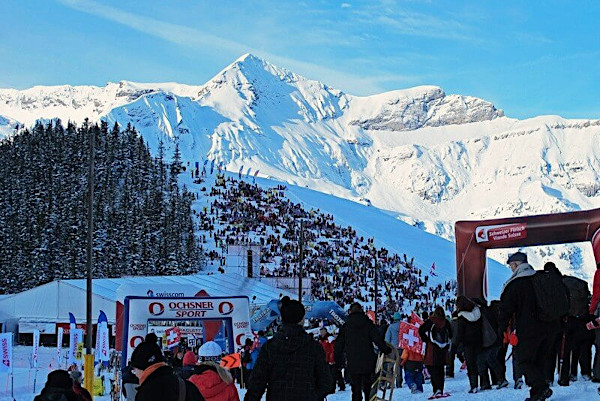
In mid-January, most of Switzerland comes to a halt to watch the Lauberhorn Downhill Ski race broadcast live on TV. The Lauberhorn course above Wengen is the longest World Cup downhill run in the world. It takes about 2½ mins for a top skier to race down from the start at 2'315 m above sea level to the finish at 1'287 m, an altitude difference of 1'028 metres over the 4,5 km long course.