Cheese types
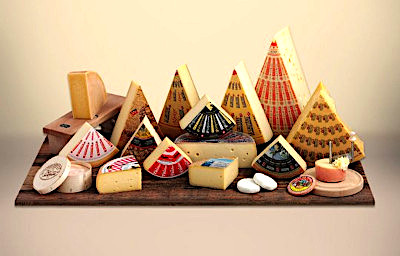
Each cheese type has own characteristics in terms of fat and water content, production method, maturation period and storage.
Extra-hard cheeses
- full-fat cheeses
- natural unpasteurized milk
- long maturation period
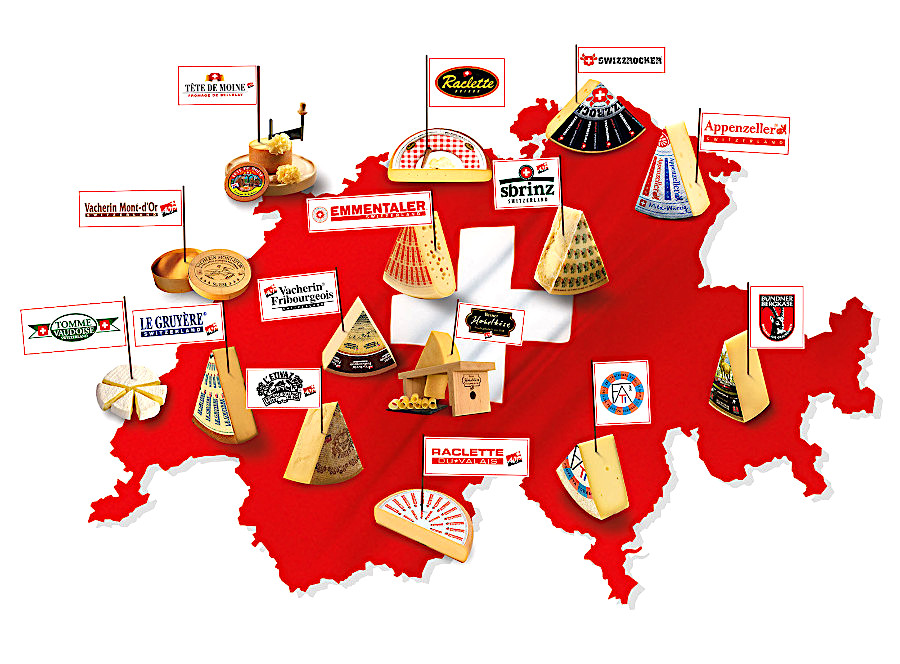
Examples: Sbrinz, Berner Hobelkäse
Hard cheeses
- 50-54% water content
- multi-use cheeses
Examples: Gruyère, Emmentaler
Semi-hard cheeses
- 54-65% water content
- raw or pasteurised milk
Examples: Raclette, Appenzeller, Tilsiter, Tête de Moine
Soft cheeses
- min. 65% water content
- pasteurised milk
- short maturation period
Examples: Tomme Vaudois, Vacherin Mont d'Or
Cream cheeses
- max. 88% min. water content
- pasteurised milk with various fat contents
- can be consumed immediately
Examples: Cottage cheese, Mozzarella, Petit Suisse, Double-cream cheese, Quark
Cheese spreads and melted cheese
- Invented in 1913 by Walter Gerber and Ritz Stettler in Thun
- Fat content of 30% to 45%
- Emulsifying salts added to turn the protein into its soluble form.
Special Swiss cheese designations
Alpkäse (Alpine cheese) = Highest priced cheeses
- Cheese must be made on site within 18 hrs of milking
- only made during the summer months (June to Sept)
- milk must come from cows (or goats or sheep) that have grazed solely on specific alpine pastures with seasonal grasses and plants (pastures that have had no artificial fertilizer).
- Alpkäse meets "Bio" quality requirements.
- Flavors and aromas typically described as "nutty, fruity, spicy, floral, herbal, grassy and/or buttery".
Bergkäse (Mountain cheese)
- made year round in the mountain valleys from raw milk from cows (or goats or sheep) from many herds which have grazed more than 80% on natural pasture (can have up to 20% grazing on artificially fertilized pastures)
- Texture rather hard, sometimes with small holes or cracks; flavour strong and often nutty.
The most common Swiss cheeses
AOP = Appellation d'Origine Controllée (Controlled designation of origin)
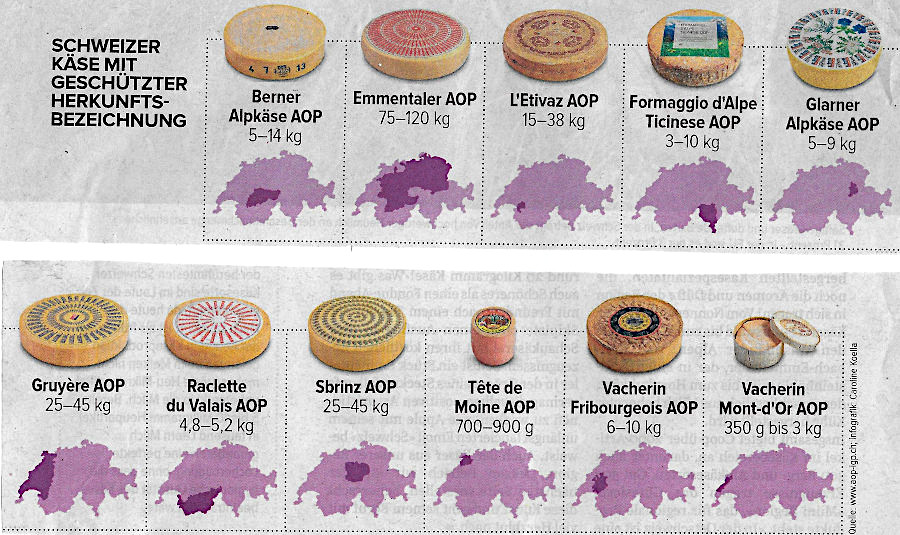
Emmentaler AOP
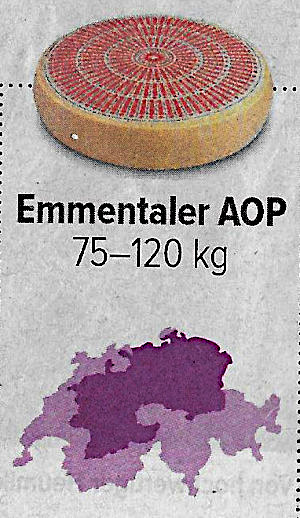
- Hard "holey" cheese
- Most well known Swiss cheese
- Production traced back to 13th century
- Aged for at least 4 months to develop its characteristic flavor.
- After 12 months, “tears” of brine form in the holes - a sure sign that the “king of cheeses” has reached full maturity, and acquired a strong flavor.
- Biggest wheel = 120 kgs
Le Gruyère AOP
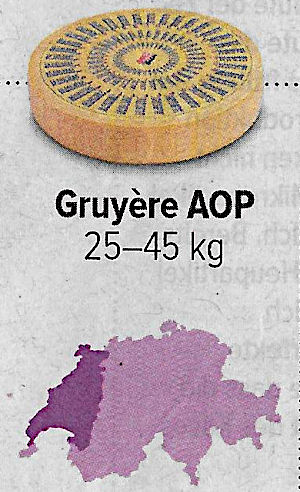
- from Fribourg
- Hard cheese
- Most sold cheese - characteristic flavour
- AD 1113, mentioned by the Count of Gruyères as the cheese provided for the Abbey of Rougemont.
- In 1602, mentioned again when the authorities in Fribourg gave each of the 14 envoys of the French embassy a wheel of “Le Gruyère” as a gift.
Raclette du Valais AOP
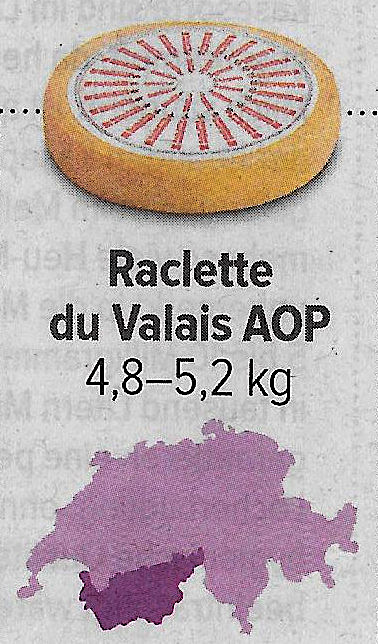
- Semi-hard cheese
- According to legend, a love-struck cheese-maker once inadvertently placed the cheese too close to a fire, so creating the “national” dish of the Valais.
- The name "raclette" (from the French “racler”, to scrape) was first used in 1909 at a wine fair in Sion
Vacherin Fribourgeois AOP
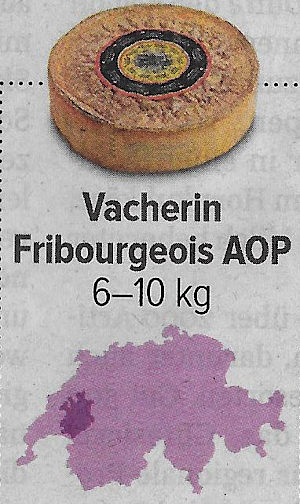
- Semi-hard cheese from canton of Fribourg only
- Fat content at least 45%
- Comes in 6 varieties
- Creamy, soft and smooth consistency
- Often used with Le Gruyère AOP for making the classic “moitié-moitié” Fondue
- Often enjoyed as a dessert cheese.
Vacherin Mont-d'Or AOP
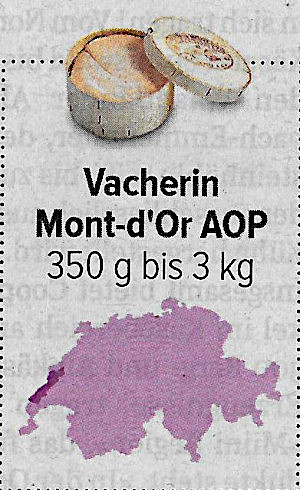
- Soft cheese always packed in box made of pine wood
- Can be warmed in the oven or eaten at room temperature - eaten with a spoon and accompanied by potatoes and crispy bread.
- Today produced from end Sept through April in the Vallée de Joux in the Vaud Jura, but originally produced from October to spring because farmers did not have enough milk to make bigger Gruyère wheels.
- Raw milk gently heated to make the cheese, then aged in traditional cellars until it acquires its characteristic creamy texture.
Tête de Moine AOP (Monk's Head)
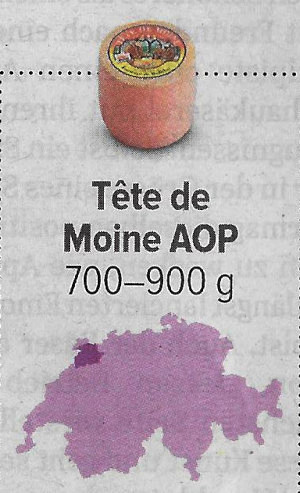
- Semi-hard cheese
- Cylindrical in shape
- Produced in 12th century at Bellelay Abbey (Bernese Jura) where the monks savoured it in a similar way to their customers - princes and ecclesiastical dignitaries.
- Shaved (not cut !) into delicate rosettes using a device known as the 'girolle' to bring more air into contact with the cheese so revealing its full flavour.
Sbrinz AOP
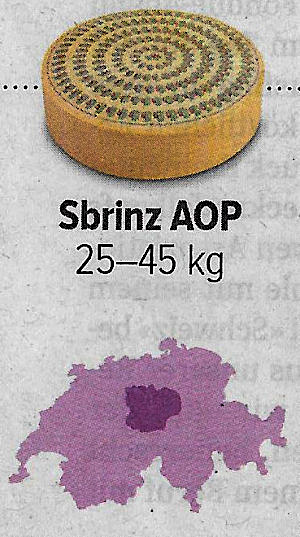
- An extra-hard cheese, good for grating
- Made at 32 cheese dairies in the valleys and summer pastures of Central Switzerland.
- One of country's oldest dairy products - in the Middle Ages was carried over mule trails to Italy.
- Made from raw milk, rennet and salt, and it takes time to develop its full flavour.
- Ageing takes at least 18 months, after which it can be sliced into wafer-thin curls.
- From the age of 24 months, broken into chunks - makes an ideal accompaniment for aperitifs
Other popular Swiss cheeses
APPENZELLER
- From north -eastern Switzerland
- Spiciest of all Swiss cheeses hard cheeses
- Flavor from herbal brine that cheese-makers rub into rind.
- After 3 months = mild; 4 months = Surchoix; 6 months= Extra
- After 3 months = mild; 4 months = Surchoix; 6 months= Extra
- Strictly limited production area = cantons of Appenzell Innerrhoden, and parts of St. Gallen + Thurgau.
TILSITER
- Hard cheese developed in 19th century by Swiss cheesemaker in Tilsit, East Prussia (now part of Russia)
- After returning to Switzerland, he refined his recipe and Swiss Tilsiter was born.
- Considerably spicier than its foreign relatives, has fewer holes, and requires a longer ageing period (at least 3½ to 5 months).
BÜNDNER BERGKÄSE
- From Graubünden
- Made from milk from cows that graze on alpine meadows at more than 1,000 metres (3000 ft),
- Only a few selected dairies are allowed to make this cheese by hand.
- Full flavor develops after aging period of up to 9 months
Some Swiss Cheese Statistics
Average annual production:
188,000 tons cows milk cheese
1,050 tons goats milk cheese
343 tons sheeps milk cheese
Biggest Alp cheese ever made:
2012 on Stoos, weighed 193 kgs (425 lbs)
Highest altitude dairy:
Alp Furggen in Valais - 2,343 m (7,700 ft)
Oldest branded cheese:
Glarner goats cheese - since 1463 Glarus regulations require stamp of origin.
Reputed oldest wheel of cheese still in existence:
made in 1875 near Grimentz/VS
See also