Swiss wine production
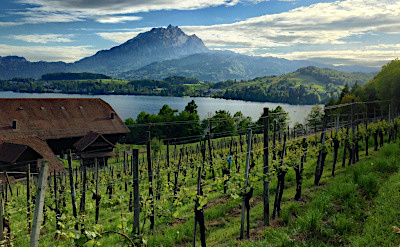
- Area under viticultivation = 14,800 hectares (approx. 37,000 acres)
- Annual production = approx 1 million hectolitres (or 26 million US Gals)
- Swiss wine exports = less than 1,5% of production (mainly to Swiss Embassies around the world)
- 252 grape varieties currently cultivated but 73% of production focused on 4 main varieties
- 57% = Red grape varieties 43% = White varieties

6 Main Wine Regions
Wine is produced in every Swiss canton!
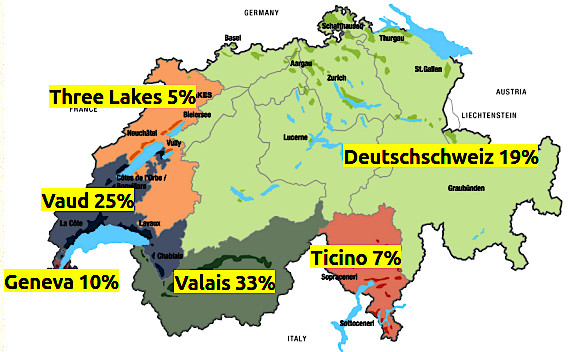
Switzerland's diversity in micro-climates, geology and soil types due to the Alps, gives each region its own identity.
South of Alps : sunnier climate influenced by Mediterranean.
North of Alps : affected by Atlantic Ocean weather.

Main varietals grown in Switzerland
80 varieties are considered Swiss in origin or by tradition - 21 are “heritage” grapes that form the core of Swiss wine identity, and 59 are hybrids.

A little history of Swiss Wine Making
- 800 BC - Celtic tribes cultivated grape vines in Switzerland - even before the Romans arrived.
- In Medieval times, monasteries cultivated vineyards on their vast land holdings and monks became expert wine makers. They brought grape varieties from Germany, Italy and France - many are still grown in Switzerland but have disappeared in their place of origin.

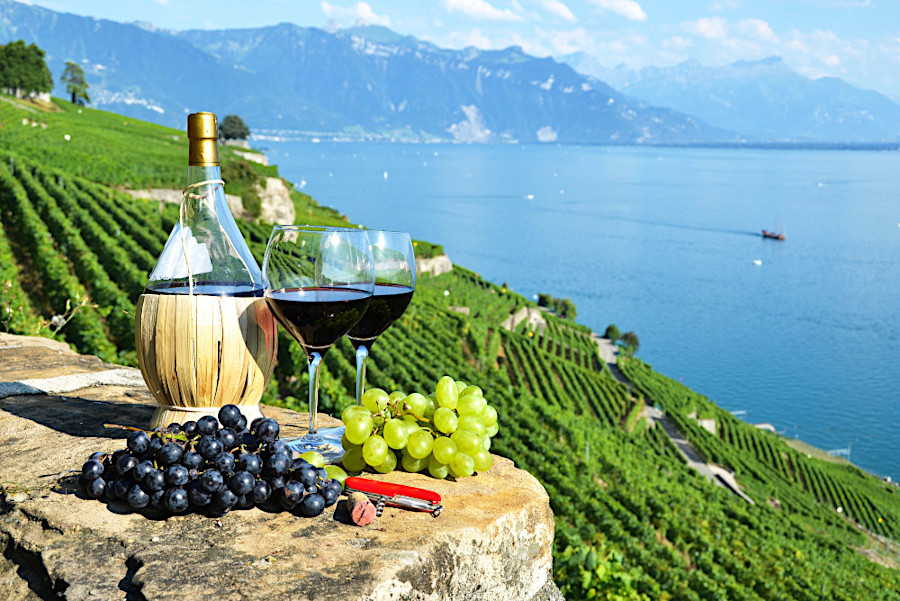
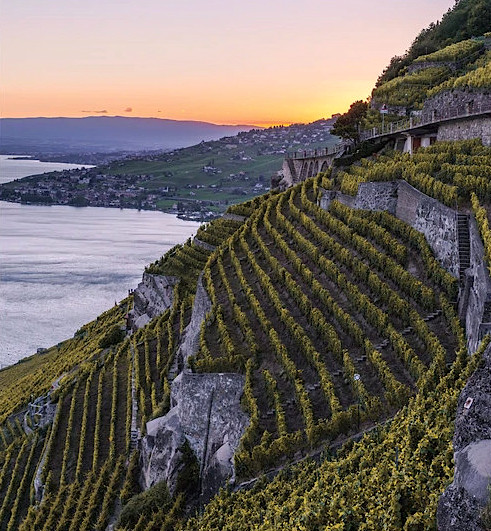
- Steep terraced vineyards of the Lavaux region on Lake Geneva were begun in 12th century by monks from Dézaley, a branch of the Cistercian monastery of Citeaux. These Lavaux vineyards are now a UNESCO World Heritage site.
- mid-19th C - the Phylloxera pest largely destroyed Swiss vineyards; to combat it, resistant American rootstocks were grafted with local varieties - with much success.

- 1906 - Ticino vineyards began cultivating Merlot in place of standard Bandolo variety - conditions excellent so now Merlot accounts for 90% of grape varieties grown in Ticino.
- By mid-20th C the country was producing lakes of wine of middling quality and high acidity; wine makers received guaranteed prices by the state, and strict import controls prevented competition from cheap imports.
- In 1990 - Control on imports were lifted and guaranteed prices stopped. This caused a crisis in the industry! The country was flooded with cheap wine imported from neighboring countries. Hundreds of “Saturday wine makers” were put out of business leaving only the serious winemakers.
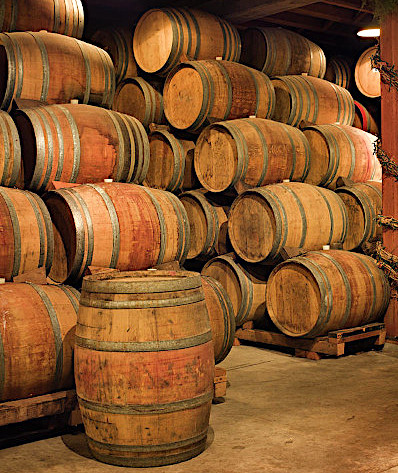
Their response : they took the view that Swiss wine makers are not able to compete with cheap imports so:
- focus on QUALITY not Quantity - create many blended wines to reduce acidity, improve color etc.
- invest in modernising vineyards and production facilities;
- produce rare and unique wines.
The Swiss Federal government provides funding for state of the art wine research institutes which do pioneer work in creating new grape varieties for disease resistance and changing climate, and resurrecting ancient varieties.
Wine consumption in Switzerland
38 litres per capita = 4th in the world by annual wine consumption per capita.
Switzerland imports 135 million hectolitres per year.

Swiss Red Wines to try
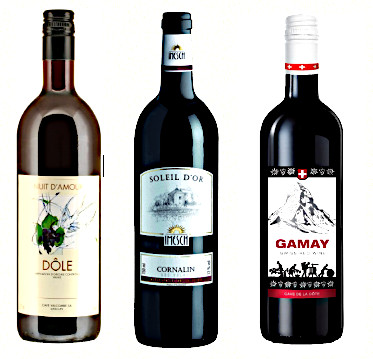
Dôle
The most 'Swiss' of red blends
A mix of 85% Pinot Noir and Gamay, and small portion of other varieties (Merlot or Syrah) - results in a wine with many variations according to terroir and producer.
Cornalin
(old names Rouge du Pays or Landroter)
considered indigenous - nearly wiped out in 20th C. Originally came over St Bernard Pass from Valle d'Aosta (Italy) where it has disappeared.
Symbolic red wine of Valais; exclusively grown in Valais
Gamay
Orig from village of Gamay in Burgundy; came to Switzerland around 1395 – mainly used in making Dôle.
Merlot
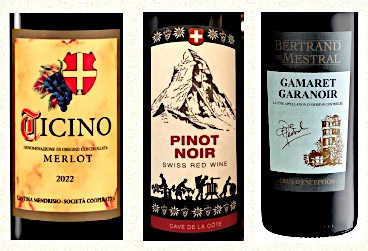
cultivated in 90% of vineyards in Ticino, becoming the symbol of the canton after its introduction in 1906, following the phylloxera crisis.
White Merlot has also become a speciality of the area.
Pinot noir / Blauburgunder
most widely cultivated wine variety in Switzerland.
Grapes originally came from Burgundy ca. 1375 – cultivazed in canton Vaud under old name of Servagnin - re-introduced in mid-19th C after Phylloxera crisis - resistant to heat and cold.
Gamaret Garanoir
Cross of Gamay and Reichensteiner - created in 1970 to obtain a variety that was similar to Gamay, but more disease resistant with a richer colour. First officially sold in 1990 - grown only in Switzerland.
Divico
Named after the legendary leader of the Celtic Helvetic tribe victorious in battle against the mighty Romans.
Divico is a new varietal created by Swiss Agroscope in 2013 out of a cross between two earlier crosses, Swiss grape Gamaret and the German Bronner.
This varietal is frost-hardy and resistant to 3 types of fungal diseases - powdery mildew, downy mildew, and grey mould (botrytis).
It is increasingly being cultivated in Great Britain and northern Europe.
In 2018 Divona, a white wine with the same “parentage” and pest-resistant qualities was launched.

Swiss White Wines to try
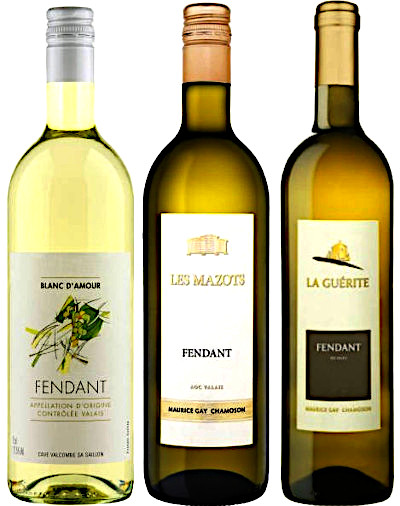
Chasselas (Vaud) or Fendant (Valais)
main white grape variety cultivated - grows in variety of soil & micro-climate types so offers many distinctly different tastes.
Main producers: Féchy, Les Murailles, St Saphorin, Dézaley, Epesses
Räuschling
originally from Germany but now vanished there - an ancient variety given new life in Switzerland - specialty of Lake Zürich vineyards where is is know as the "Zürirebe"
Arvine
indigenous to Valais- since 1602 recognised as exclusive Valais speciality under name “Arvena” (meaning "upstart, new arrival") - exclusively grown in Valais.

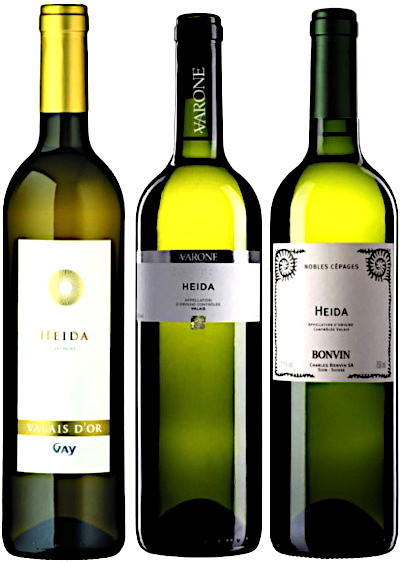
Heida (Savagnin/Traminer)
produced on steep slopes of Europe’s highest altitude vineyards at Vispertermine.
Divona
Named after the Celtic goddess of Spring; launched in 2018.
New variety created in Switzerland - after 20 years of meticulous selection from 1000s of possibles. Selected for its resistance to pests, adaptation to changing climates, production capacity and sugar content.

Humagne Blanc
originated in French Pyrenees where it has long since vanished - now considered exclusively Swiss.
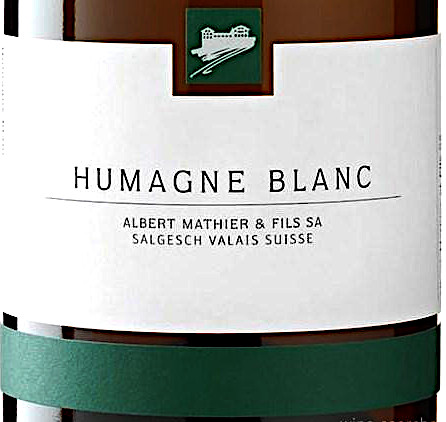
White wines - only in Switzerland
Amigne indigenous "orphan variety" (parentage is unknown) native to Valais - 70% of world production grown in Vétroz; late ripening; mainly sweet wine
Completer indigenous "orphan grape" - first officially mentioned in 1321 - name from Catholic "Completorium", the last prayers to mark the end of each day. Now only made in 1 tiny area of Graubünden.
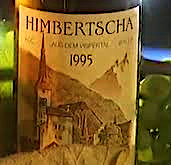
Himbertscha indigenous - extremely rare variety from Haut Valais - natural offspring of Humagne Blanc - saved from extinction in 1970s - only produced in Haut Valais.
Lafnetscha Indigenous to Valais - natural cross between Humagne Blanche and Completer - name comes from "Laff-nit-scha", dialect form of "laff es nicht schon" (= don't drink it too soon), in reference to its high acidity; now grown exclusively in Haut Valais.

Other Swiss Specialities
Oeil de Perdrix (the eye of the partridge)
A dry rosé made from Pinot Noir grapes - now a speciality of Neuchâtel area but originally came from France in Middle Ages.
Until about 100 yrs ago, common for vineyards to have red and white grapes unseparated resulting in white wine, red wine, and "grey" wine because it was neither white nor red.
With separation of grapes, term Oeil de Perdrix disappeared in France, but remained in Neuchâtel.

Rèze (or Resi)
indigenous - one of oldest varieties of Alpine region - once the dominant variety in Valais but only few vines remain - main variety for making traditional Vin du Glacier/Gletscherwein from Val d'Annivers
unique specialty sherry-style wine - stored in larch wood vats, transferred from vat to vat, youngest to oldest (similar to Jerez system) - each year wine from oldest vats (1886) bottled, then wine from next oldest vats (1888) transferred to oldest vats etc.
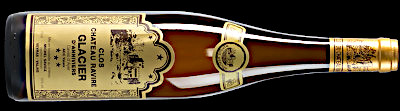
The smallest vineyard in the world that makes wine
Le Farinet - 1,67 m2
La Vigne à Farinet is the smallest registered vineyard in the world. It is owned by the Dalai Lama who was bequeathed it.
It is named after Joseph-Samuel Farinet (1845-1880), a smuggler and counterfeiter, sometimes called the Swiss Robin Hood.
Located in Saillon, canton Valais, it has 3 vines and each year personalities from the arts, politics or sports work the vineyard.
The yearly harvest is mixed with the best Valais wine to produce 1,000 numbered bottles which are sold for charitable causes.
