
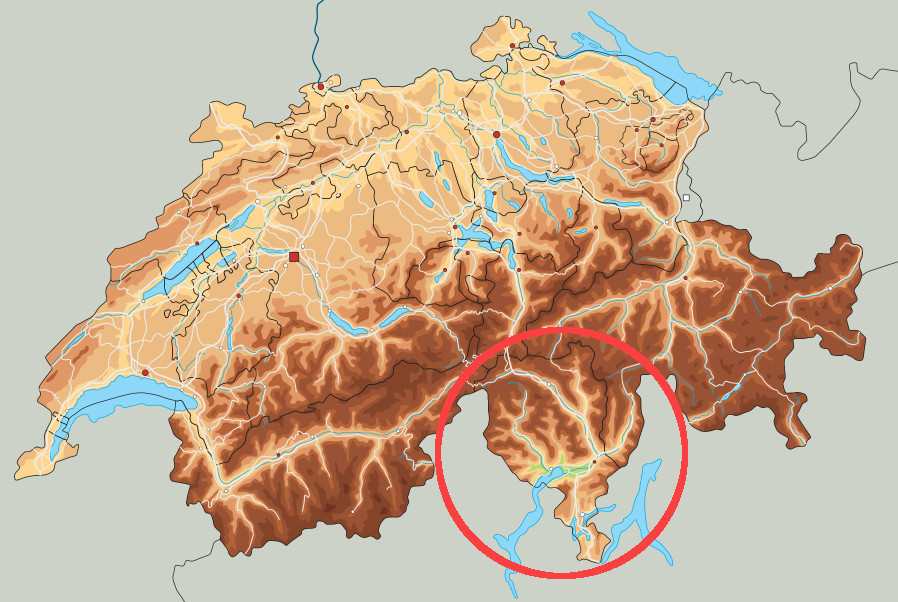
In the 1870s the Italian government imposed protective duties on various goods but the Swiss maintained the principle of free trade. This created significant price differences which made smuggling from Switzerland south into Italy extremely profitable.
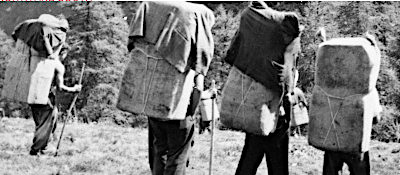
Activity increased considerably during the World Wars when the Swiss, suffering from food shortages, exchanged salt and cigarettes for Italian ham, rice and other consumer goods such as shoes.
After the war, in Switzerland export smuggling was seen as a crude form of 'export' - generally benignly tolerated by local authorities as many Swiss businesses on and near the border essentially made their living on the goods delivered by smugglers.
For some regions, smuggling remained of such economic importance beyond the War years that it continued until the 1990s with the tacit collusion of Swiss border guards.
The devaluation of the Italian currency in the 1970s killed profit margins in traditional smuggling. The social status of the smuggler also decreased.
What remained was a small minority of smugglers who, because of their experience, were harnessed by organized crime for drugs and illegal export of capital from Italy.
So over time, a socially accepted mass phenomenon turned into an exclusive illegal occupation tied to international crime.
Main smuggle goods:
SALT - RICE - TOBACCO - CIGARETTES - COFFEE
In 19th to beginning of the 20th C - mainly salt and tobacco was 'exported' from Switzerland to Italy.
During the World Wars the flow of goods reversed - Switzerland now imported from Italy - mainly rice. Many Italians also tried to smuggle all sorts of goods into Switzerland in order to obtain hard currency ie. Swiss francs.
People smuggling During WW2 the smugglers extended their goods to include people - Jewish refugees, deserting Italian army personnel, escaped prisoners of war. Mussolini's daughter and her children were also smuggled across to Switzerland in the closing stages of the war.
After WW2 - coffee and cigarettes were mainly smuggled from Switzerland to Italy.
An estimated ¼ to ⅓ of tobacco processed in Ticino was smuggled over the border. Small tobacco processing businesses around Chiasso were entirely dependent on the smuggling trade showing how important smuggling was for the region’s local economy.
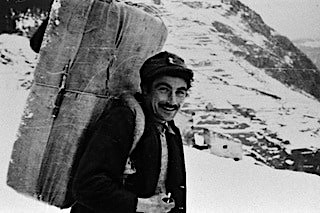
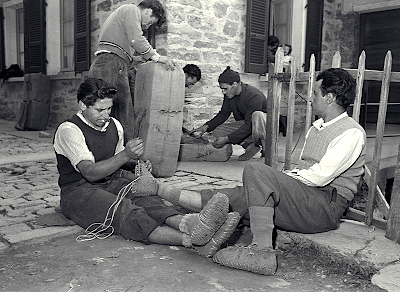
Smugglers undertook exhausting treks over the border in groups of 3 to 10 people, carrying a “bricolla” – a woven container like a large rucksack.
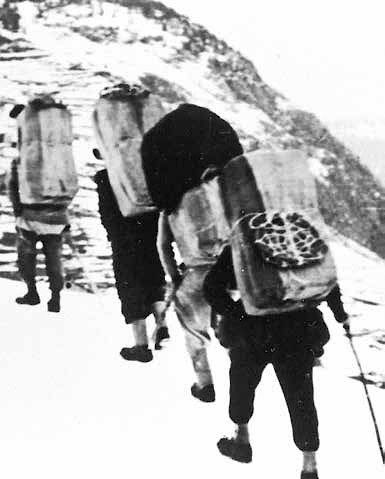
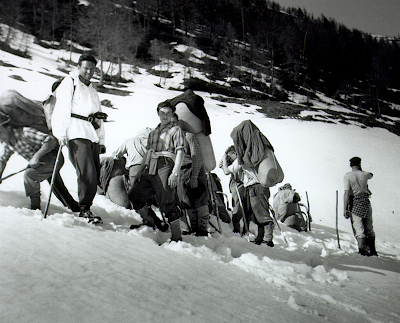
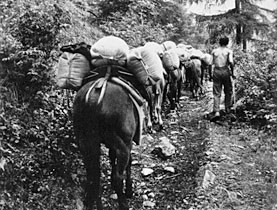
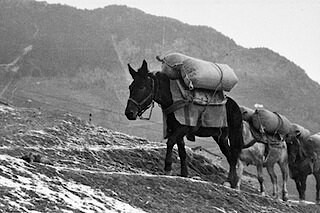
Mule trains were also used
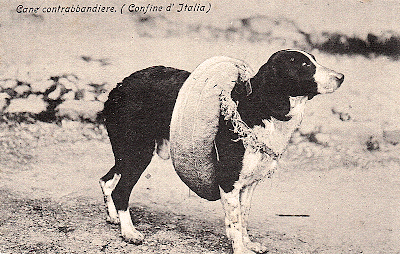
Smuggler dogs were introduced at end of 19th century - trained to cross specific routes carrying small packs weighing between 5kg and 10kg.
The smugglers made themselves special shoes (peduli) out of felt fabric to allow them to navigate through the woods as silently as possible.
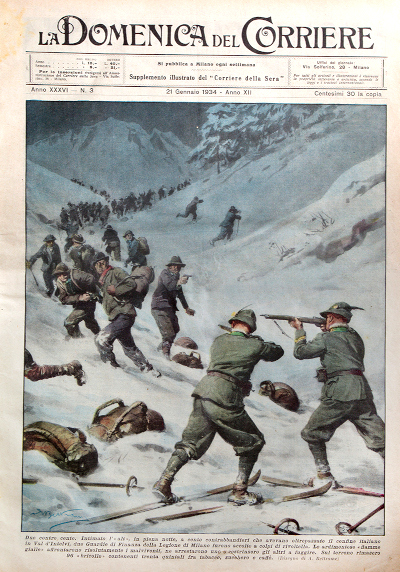
To combat smuggling, Italian border guards built a border fence network in 1880s.
The “ramina”, as it is known in Ticino, had an alarm system of bells attached with special springs, ready to sound if anyone tried to cross the border illegally.

Sometimes smugglers formed entire convoys - 1 of biggest groups ever discovered by an Italian border patrol had 131 people of all ages.
But many of the border guards came from the same poor communities as the smugglers, and as they were not well paid, they were open to bribery.
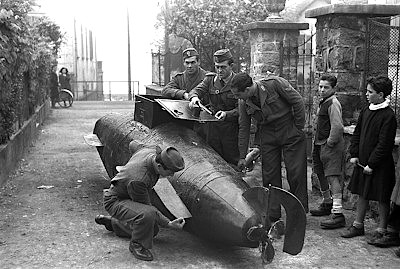
1948 - a homemade wooden submarine encased in metal was seized - it was 3 m long with a carrying capacity of 450kg - powered by pedals like a bicycle!
Coffee smuggling
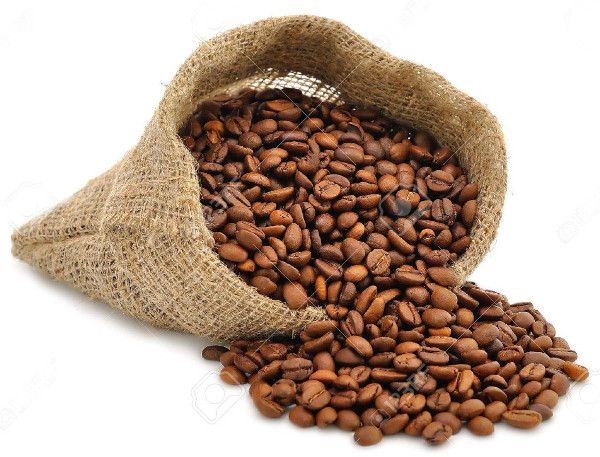
Right up to the 1970s, Brusio (on the Bernina railway route) had 6 coffee roasting plants and the whole valley would smell of roasted coffee.
From Brusio, the coffee sacks were shipped along the mountains via cable cars and mules to Italy where dozens of Italian smugglers were waiting to bring the goods illegally down into the Valtellina.
Up to 21 tons of coffee per day, filled into about 600 "bricolle" (jute sacks with smuggled goods) of 30 to 40 kgs (66-88 lbs) each per man and 25 kgs (55 lbs) per woman.
On the Swiss side, everything was completely legal. A special administrative term was even created for this type of export: "Export 2".
Stories of a former border guard
Domenic Gisep (1910-2000) was border guard between 1940 and 1944. In an interview in 1999, he recalled numerous anecdotes about smuggling across the national border between Poschiavo valley in Switzerland and Veltlin valley in Italy
https://www.swissinfo.ch/ger/schmuggel-epos-zwischen-veltlin-und-puschlav/586504
Sausages under the cassock
"Don Felicissimo was the village priest of Viano. He often went to Italy, to Tirano and Baruffini. Once I met him just as he was returning to Viano, that is, to Switzerland.
I knew that they had just slaughtered a pig on the Italian side. Surely he had sausages hidden under his cassock. But I did not say a word. What was I supposed to do with his sausages?"
Smuggled encyclopaedias
"I remember how a smuggler carried the 30 volumes of the Enciclopedia Treccani all the way to Viano.
They were destined for the Reformed theologian Giovanni Luzzi, who had translated the bible into Italian. Luzzi was then Protestant pastor in Poschiavo.
Later, Luzzi gave me the 30 volumes. I always took them with me when I moved from one border post to another in the ministry."
In Italian uniform
"Once I went to Tirano in the uniform of an Italian sergeant. The Swiss Army wanted to know how many troops the (German) Wehrmacht had stationed in Tirano.
On the way back I stopped in Baruffini and was invited by a smuggler for a coffee.
A little girl saw me and said, "that's the Gisep!" Whereupon I disappeared as quickly as I could. If the smugglers had noticed my disguise, there would certainly have been problems"